 Home
Home Intranet
 Faculty of Science
 Contact Us

Large Discovery Models: Towards Autonomous Scientific Discovery
| Date | 24 Sep 2026 |
| Time | 10:00 am - 11:00 am (HKT) |
| Venue | Tam Wing Fan Innovation Wing Two, G/F Run Run Shaw Building |
| Speaker | Prof. Jun Wang |
| Institution | University College London |
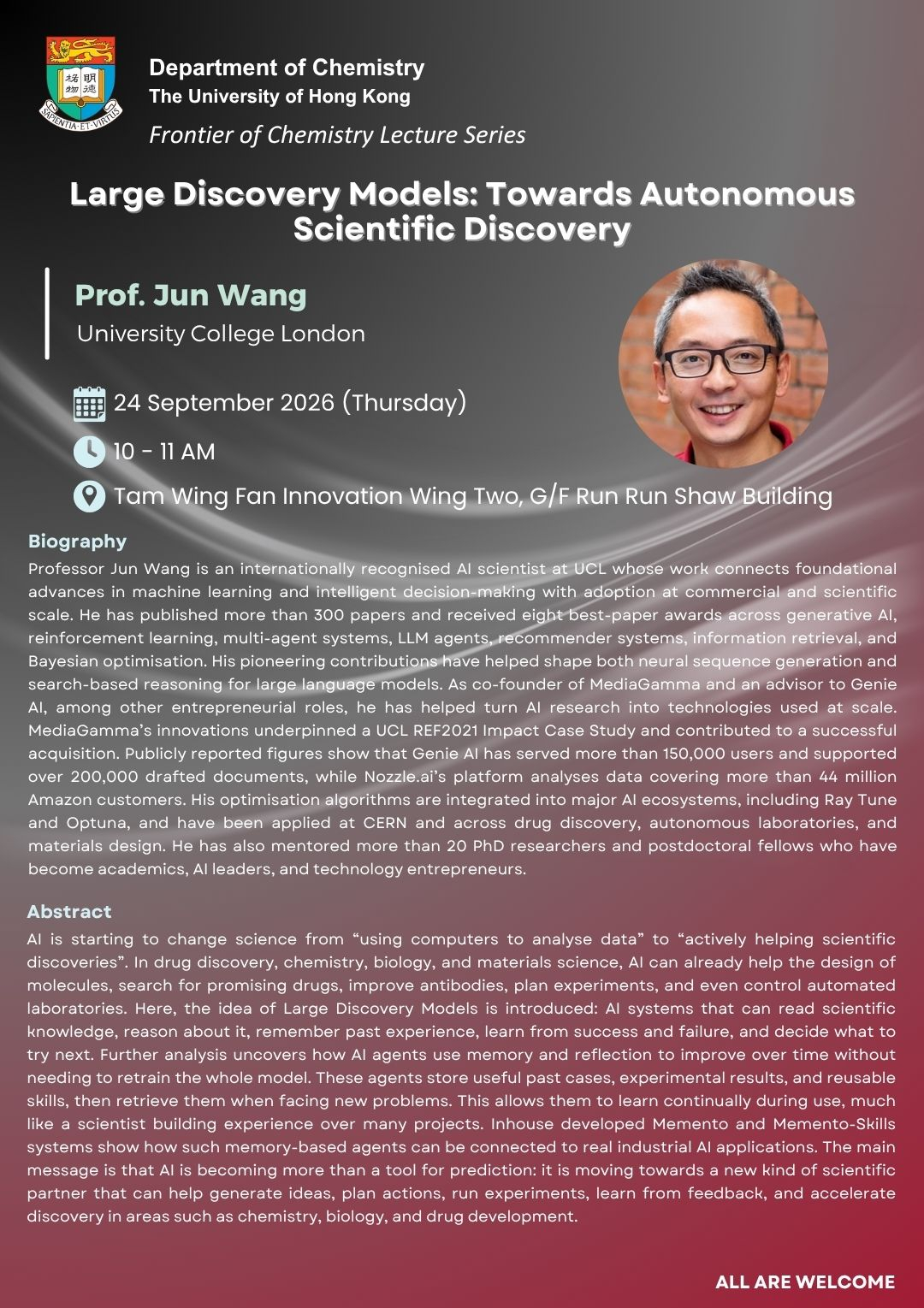
Large Discovery Models: Towards Autonomous Scientific Discovery
Schedule:
Date: 24th September, 2026 (Thursday)
Time: 10 - 11 am (HKT)
Venue: Tam Wing Fan Innovation Wing Two, G/F Run Run Shaw Building
Speaker:
Prof. Jun Wang
University College London
Abstract:
AI is starting to change science from “using computers to analyse data” to “actively helping scientific discoveries”. In drug discovery, chemistry, biology, and materials science, AI can already help the design of molecules, search for promising drugs, improve antibodies, plan experiments, and even control automated laboratories. Here, the idea of Large Discovery Models is introduced: AI systems that can read scientific knowledge, reason about it, remember past experience, learn from success and failure, and decide what to try next. Further analysis uncovers how AI agents use memory and reflection to improve over time without needing to retrain the whole model. These agents store useful past cases, experimental results, and reusable skills, then retrieve them when facing new problems. This allows them to learn continually during use, much like a scientist building experience over many projects. Inhouse developed Memento and Memento-Skills systems show how such memory-based agents can be connected to real industrial AI applications. The main message is that AI is becoming more than a tool for prediction: it is moving towards a new kind of scientific partner that can help generate ideas, plan actions, run experiments, learn from feedback, and accelerate discovery in areas such as chemistry, biology, and drug development.
- - ALL ARE WELCOME - -