 Home
Home Intranet
 Faculty of Science
 Contact Us

Microstructure of Conjugated Polymers from solution to thin film
| Date | 29 Sep 2026 |
| Time | 4:00 pm - 4:50 pm (HKT) |
| Venue | Lecture Theatre P4, Chong Yuet Ming Physics Building |
| Speaker | Prof. Jian Pei |
| Institution | College of Chemistry and Molecular Engineering, Peking University |
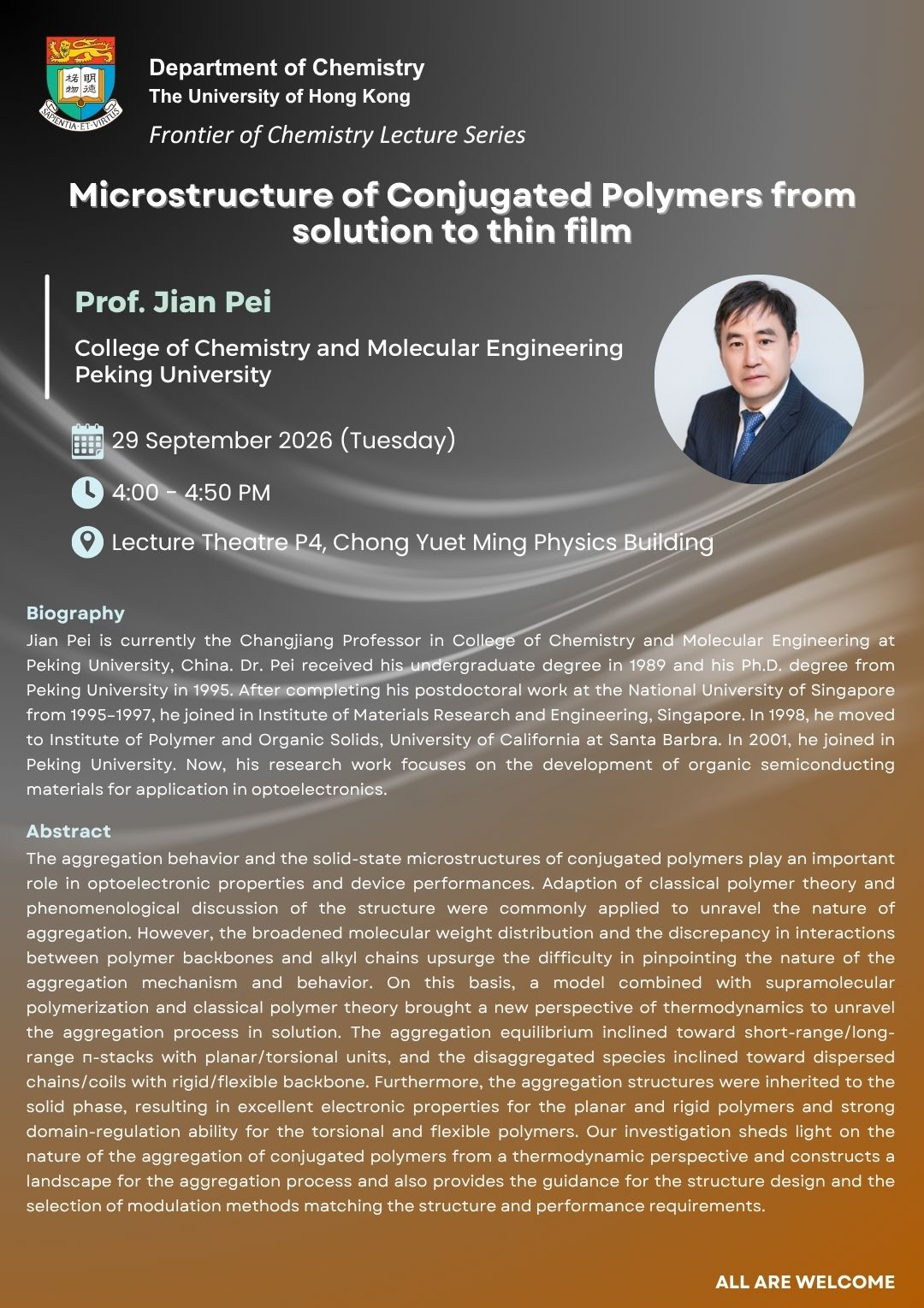
Title:
Microstructure of Conjugated Polymers from solution to thin film
Schedule:
Date: 29th September, 2026 (Tuesday)
Time: 4:00 - 4:50 pm (HKT)
Venue: Lecture Theatre P4, Chong Yuet Ming Physics Building
Speaker:
Prof. Jian Pei
College of Chemistry and Molecular Engineering
Peking University
Biography:
Jian Pei is currently the Changjiang Professor in College of Chemistry and Molecular Engineering at Peking University, China. Dr. Pei received his undergraduate degree in 1989 and his Ph.D. degree from Peking University in 1995. After completing his postdoctoral work at the National University of Singapore from 1995–1997, he joined in Institute of Materials Research and Engineering, Singapore. In 1998, he moved to Institute of Polymer and Organic Solids, University of California at Santa Barbra. In 2001, he joined in Peking University. Now, his research work focuses on the development of organic semiconducting materials for application in optoelectronics.
Abstract:
The aggregation behavior and the solid-state microstructures of conjugated polymers play an important role in optoelectronic properties and device performances. Adaption of classical polymer theory and phenomenological discussion of the structure were commonly applied to unravel the nature of aggregation. However, the broadened molecular weight distribution and the discrepancy in interactions between polymer backbones and alkyl chains upsurge the difficulty in pinpointing the nature of the aggregation mechanism and behavior. On this basis, a model combined with supramolecular polymerization and classical polymer theory brought a new perspective of thermodynamics to unravel the aggregation process in solution. The aggregation equilibrium inclined toward short-range/long-range π-stacks with planar/torsional units, and the disaggregated species inclined toward dispersed chains/coils with rigid/flexible backbone. Furthermore, the aggregation structures were inherited to the solid phase, resulting in excellent electronic properties for the planar and rigid polymers and strong domain-regulation ability for the torsional and flexible polymers. Our investigation sheds light on the nature of the aggregation of conjugated polymers from a thermodynamic perspective and constructs a landscape for the aggregation process and also provides the guidance for the structure design and the selection of modulation methods matching the structure and performance requirements.
- - ALL ARE WELCOME - -