 Home
Home Intranet
 Faculty of Science
 Contact Us

Protein Folding and Misfolding on the Ribosome
| Date | 24 Sep 2026 |
| Time | 12:00 pm - 1:00 pm (HKT) |
| Venue | Lecture Theatre T2, Meng Wah Complex |
| Speaker | Prof. John Christodoulou |
| Institution | University College London |
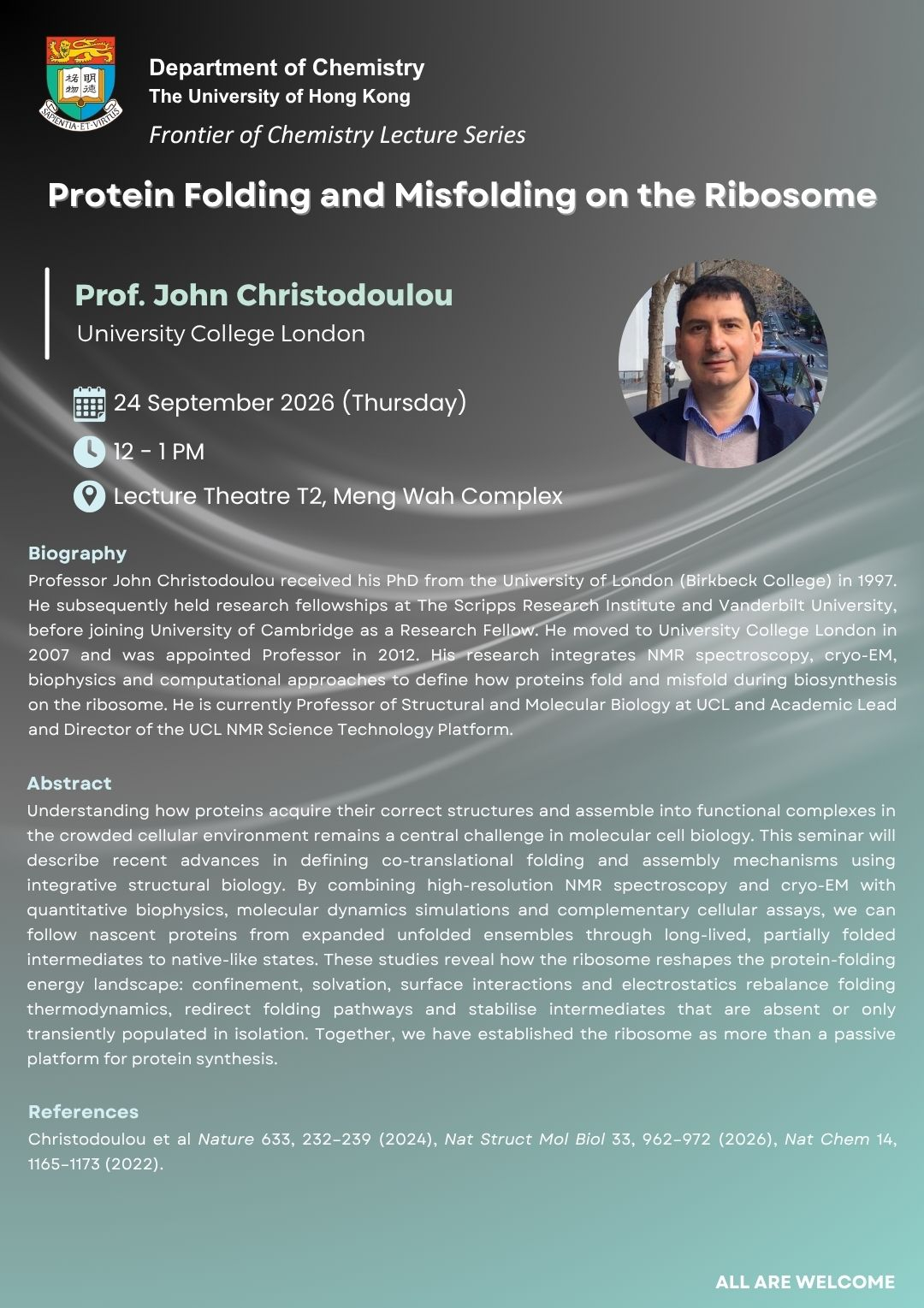
Title:
Protein Folding and Misfolding on the Ribosome
Schedule:
Date: 24th September, 2026 (Thursday)
Time: 12 - 1 pm (HKT)
Venue: Lecture Theatre T2, Meng Wah Complex
Speaker:
Prof. John Christodoulou
University College London
Biography:
Professor John Christodoulou received his PhD from the University of London (Birkbeck College) in 1997. He subsequently held research fellowships at The Scripps Research Institute and Vanderbilt University, before joining University of Cambridge as a Research Fellow. He moved to University College London in 2007 and was appointed Professor in 2012. His research integrates NMR spectroscopy, cryo-EM, biophysics and computational approaches to define how proteins fold and misfold during biosynthesis on the ribosome. He is currently Professor of Structural and Molecular Biology at UCL and Academic Lead and Director of the UCL NMR Science Technology Platform.
Abstract:
Understanding how proteins acquire their correct structures and assemble into functional complexes in the crowded cellular environment remains a central challenge in molecular cell biology. This seminar will describe recent advances in defining co-translational folding and assembly mechanisms using integrative structural biology. By combining high-resolution NMR spectroscopy and cryo-EM with quantitative biophysics, molecular dynamics simulations and complementary cellular assays, we can follow nascent proteins from expanded unfolded ensembles through long-lived, partially folded intermediates to native-like states. These studies reveal how the ribosome reshapes the protein-folding energy landscape: confinement, solvation, surface interactions and electrostatics rebalance folding thermodynamics, redirect folding pathways and stabilise intermediates that are absent or only transiently populated in isolation. Together, we have established the ribosome as more than a passive platform for protein synthesis.
References:
Christodoulou et al Nature 633, 232–239 (2024), Nat Struct Mol Biol 33, 962–972 (2026), Nat Chem 14, 1165–1173 (2022).
- - ALL ARE WELCOME - -