 Home
Home Intranet
 Faculty of Science
 Contact Us

Corroles at work: a small macrocycle for great applications
| Date | 22 Oct 2026 |
| Time | 9:30 am - 10:30 am (HKT) |
| Venue | Classroom 3, Library Extension Building |
| Speaker | Prof. Claude Gros |
| Institution | Université Bourgogne Europe |
Title:
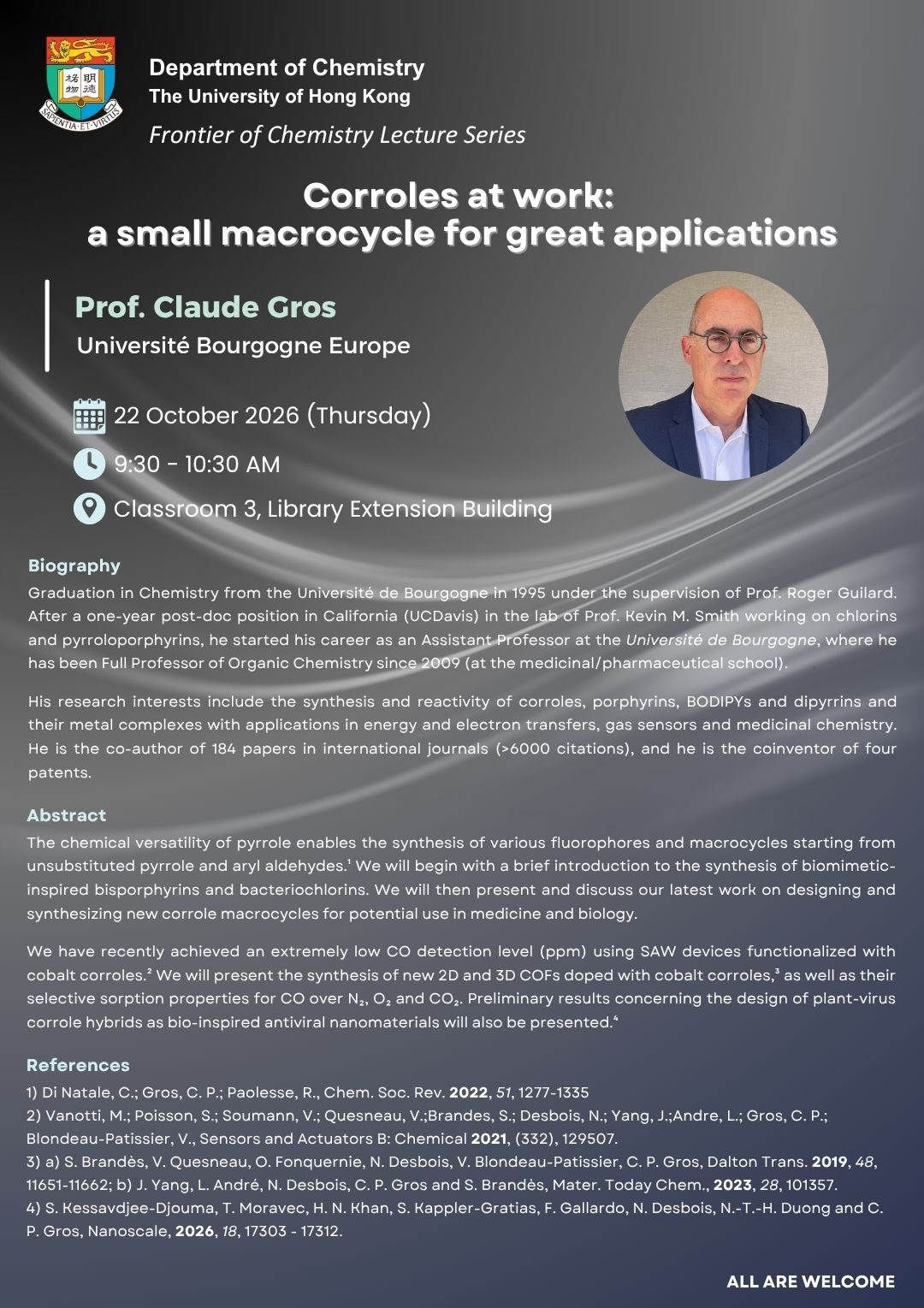
Corroles at work: a small macrocycle for great applications
Schedule:
Date: 22nd October, 2026 (Thursday)
Time: 9:30 -10:30 am (HKT)
Venue: Classroom 3, Library Extension Building
Speaker:
Prof. Claude Gros
Université Bourgogne Europe
Biography:
Graduation in Chemistry from the Université de Bourgogne in 1995 under the supervision of Prof. Roger Guilard. After a one-year post-doc position in California (UCDavis) in the lab of Prof. Kevin M. Smith working on chlorins and pyrroloporphyrins, he started his career as an Assistant Professor at the Université de Bourgogne, where he has been Full Professor of Organic Chemistry since 2009 (at the medicinal/pharmaceutical school).
His research interests include the synthesis and reactivity of corroles, porphyrins, BODIPYs and dipyrrins and their metal complexes with applications in energy and electron transfers, gas sensors and medicinal chemistry. He is the co-author of 184 papers in international journals (>6000 citations), and he is the coinventor of four patents.
Abstract:
The chemical versatility of pyrrole enables the synthesis of various fluorophores and macrocycles starting from unsubstituted pyrrole and aryl aldehydes.¹ We will begin with a brief introduction to the synthesis of biomimetic-inspired bisporphyrins and bacteriochlorins. We will then present and discuss our latest work on designing and synthesizing new corrole macrocycles for potential use in medicine and biology.
We have recently achieved an extremely low CO detection level (ppm) using SAW devices functionalized with cobalt corroles.² We will present the synthesis of new 2D and 3D COFs doped with cobalt corroles,³ as well as their selective sorption properties for CO over N₂, O₂ and CO₂. Preliminary results concerning the design of plant-virus corrole hybrids as bio-inspired antiviral nanomaterials will also be presented.⁴
References:
1) Di Natale, C.; Gros, C. P.; Paolesse, R., Chem. Soc. Rev. 2022, 51, 1277-1335
2) Vanotti, M.; Poisson, S.; Soumann, V.; Quesneau, V.;Brandes, S.; Desbois, N.; Yang, J.;Andre, L.; Gros, C. P.; Blondeau-Patissier, V., Sensors and Actuators B: Chemical 2021, (332), 129507.
3) a) S. Brandès, V. Quesneau, O. Fonquernie, N. Desbois, V. Blondeau-Patissier, C. P. Gros, Dalton Trans. 2019, 48, 11651-11662; b) J. Yang, L. André, N. Desbois, C. P. Gros and S. Brandès, Mater. Today Chem., 2023, 28, 101357.
4) S. Kessavdjee-Djouma, T. Moravec, H. N. Khan, S. Kappler-Gratias, F. Gallardo, N. Desbois, N.-T.-H. Duong and C. P. Gros, Nanoscale, 2026, 18, 17303 - 17312.
- - ALL ARE WELCOME - -