 Home
Home Intranet
 Faculty of Science
 Contact Us
 EventsSeminars and ConferencesA radical approach to chemical synthesis enabled by sustainable (photo)catalysis Back
A radical approach to chemical synthesis enabled by sustainable (photo)catalysis
| Date | 31 Aug 2026 |
| Time | 10:00 am - 11:00 am (HKT) |
| Venue | Lecture Theatre P2, Chong Yuet Ming Physics Building |
| Speaker | Dr. Kangjie Bian |
| Institution | Scripps Research |
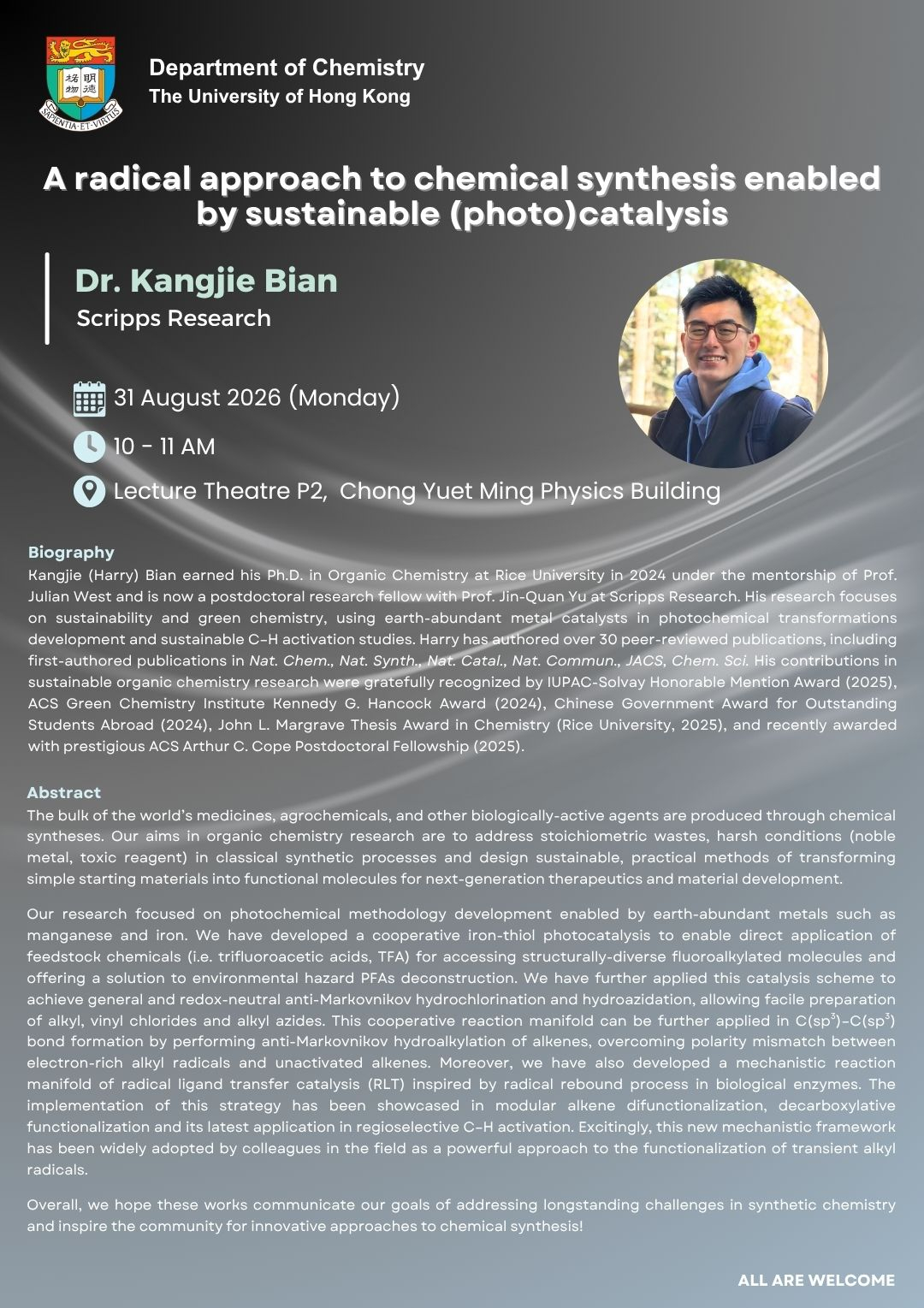
Title:
A radical approach to chemical synthesis enabled by sustainable (photo)catalysis
Schedule:
Date: 31st August, 2026 (Monday)
Time: 10 - 11 am (HKT)
Venue: Lecture Theatre P2, Chong Yuet Ming Physics Building
Speaker:
Dr. Kangjie Bian
Scripps Research
Biography:
Kangjie (Harry) Bian earned his Ph.D. in Organic Chemistry at Rice University in 2024 under the mentorship of Prof. Julian West and is now a postdoctoral research fellow with Prof. Jin-Quan Yu at Scripps Research. His research focuses on sustainability and green chemistry, using earth-abundant metal catalysts in photochemical transformations development and sustainable C–H activation studies. Harry has authored over 30 peer-reviewed publications, including first-authored publications in Nat. Chem., Nat. Synth., Nat. Catal., Nat. Commun., JACS, Chem. Sci. His contributions in sustainable organic chemistry research were gratefully recognized by IUPAC-Solvay Honorable Mention Award (2025), ACS Green Chemistry Institute Kennedy G. Hancock Award (2024), Chinese Government Award for Outstanding Students Abroad (2024), John L. Margrave Thesis Award in Chemistry (Rice University, 2025), and recently awarded with prestigious ACS Arthur C. Cope Postdoctoral Fellowship (2025).
Abstract:
The bulk of the world’s medicines, agrochemicals, and other biologically-active agents are produced through chemical syntheses. Our aims in organic chemistry research are to address stoichiometric wastes, harsh conditions (noble metal, toxic reagent) in classical synthetic processes and design sustainable, practical methods of transforming simple starting materials into functional molecules for next-generation therapeutics and material development.
Our research focused on photochemical methodology development enabled by earth-abundant metals such as manganese and iron. We have developed a cooperative iron-thiol photocatalysis to enable direct application of feedstock chemicals (i.e. trifluoroacetic acids, TFA) for accessing structurally-diverse fluoroalkylated molecules and offering a solution to environmental hazard PFAs deconstruction. We have further applied this catalysis scheme to achieve general and redox-neutral anti-Markovnikov hydrochlorination and hydroazidation, allowing facile preparation of alkyl, vinyl chlorides and alkyl azides. This cooperative reaction manifold can be further applied in C(sp3)–C(sp3) bond formation by performing anti-Markovnikov hydroalkylation of alkenes, overcoming polarity mismatch between electron-rich alkyl radicals and unactivated alkenes. Moreover, we have also developed a mechanistic reaction manifold of radical ligand transfer catalysis (RLT) inspired by radical rebound process in biological enzymes. The implementation of this strategy has been showcased in modular alkene difunctionalization, decarboxylative functionalization and its latest application in regioselective C–H activation. Excitingly, this new mechanistic framework has been widely adopted by colleagues in the field as a powerful approach to the functionalization of transient alkyl radicals.
Overall, we hope these works communicate our goals of addressing longstanding challenges in synthetic chemistry and inspire the community for innovative approaches to chemical synthesis!
- - ALL ARE WELCOME - -