 Home
Home Intranet
 Faculty of Science
 Contact Us
 EventsSeminars and ConferencesProgrammable Polymer Design and Dynamic Responsiveness for Adaptive Biological Functions Back
Programmable Polymer Design and Dynamic Responsiveness for Adaptive Biological Functions
| Date | 17 Sep 2026 |
| Time | 6:00 - 6:50 pm (HKT) |
| Venue | Lecture Theatre P1, Chong Yuet Ming Chemistry Building |
| Speaker | Dr. Suiying Ye |
| Institution | ETH Zürich |
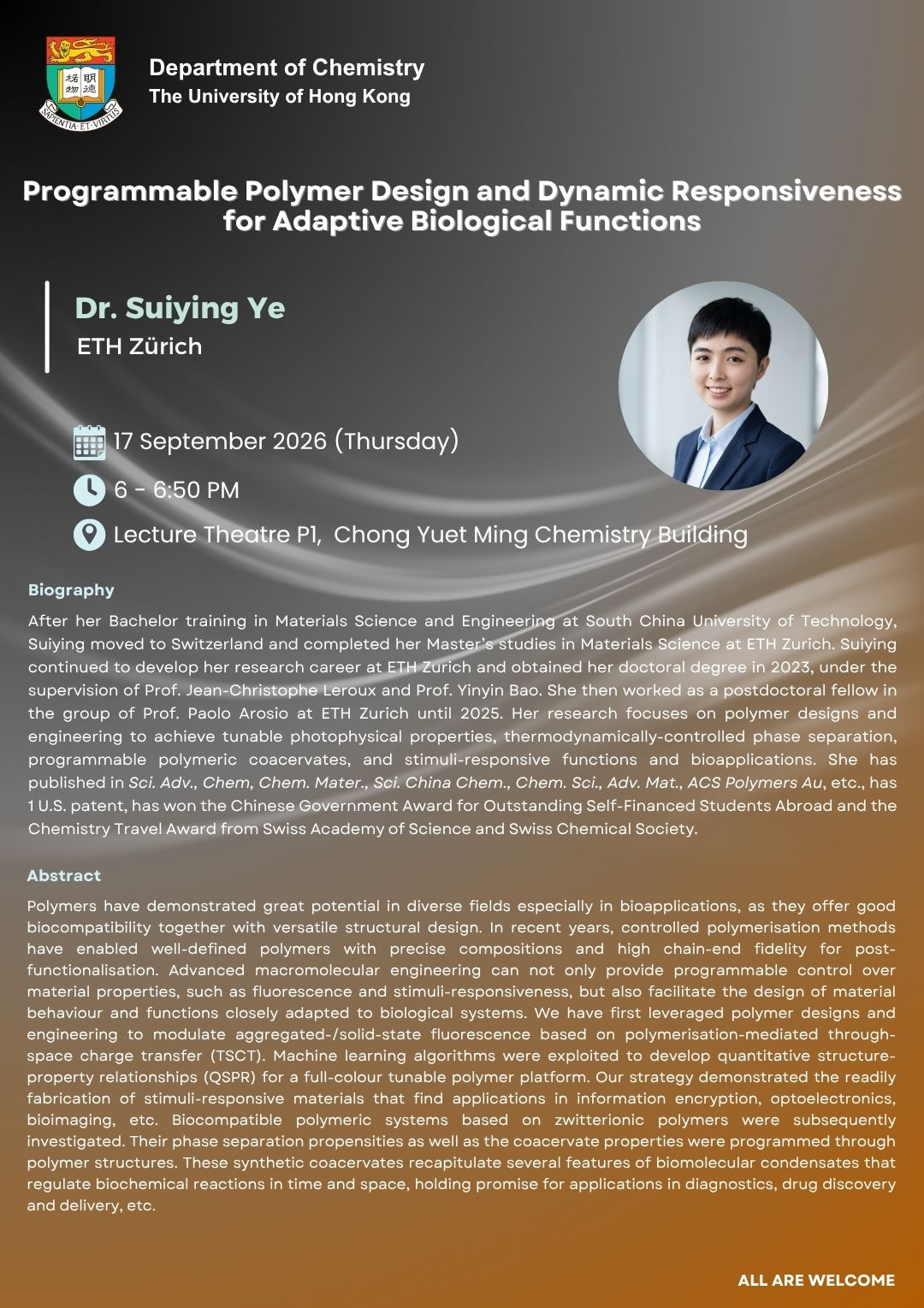
Title:
Programmable Polymer Design and Dynamic Responsiveness for Adaptive Biological Functions
Schedule:
Date: 17th September, 2026 (Wednesday)
Time: 6 - 6:50 pm (HKT)
Venue: Lecture Theatre P1, Chong Yuet Ming Chemistry Building
Speaker:
Dr. Suiying Ye
ETH Zürich
Biography:
After her Bachelor training in Materials Science and Engineering at South China University of Technology, Suiying moved to Switzerland and completed her Master’s studies in Materials Science at ETH Zurich. Suiying continued to develop her research career at ETH Zurich and obtained her doctoral degree in 2023, under the supervision of Prof. Jean-Christophe Leroux and Prof. Yinyin Bao. She then worked as a postdoctoral fellow in the group of Prof. Paolo Arosio at ETH Zurich until 2025. Her research focuses on polymer designs and engineering to achieve tunable photophysical properties, thermodynamically-controlled phase separation, programmable polymeric coacervates, and stimuli-responsive functions and bioapplications. She has published in Sci. Adv., Chem, Chem. Mater., Sci. China Chem., Chem. Sci., Adv. Mat., ACS Polymers Au, etc., has 1 U.S. patent, has won the Chinese Government Award for Outstanding Self-Financed Students Abroad and the Chemistry Travel Award from Swiss Academy of Science and Swiss Chemical Society.
Abstract:
Polymers have demonstrated great potential in diverse fields especially in bioapplications, as they offer good biocompatibility together with versatile structural design. In recent years, controlled polymerisation methods have enabled well-defined polymers with precise compositions and high chain-end fidelity for post-functionalisation. Advanced macromolecular engineering can not only provide programmable control over material properties, such as fluorescence and stimuli-responsiveness, but also facilitate the design of material behaviour and functions closely adapted to biological systems. We have first leveraged polymer designs and engineering to modulate aggregated-/solid-state fluorescence based on polymerisation-mediated through-space charge transfer (TSCT). Machine learning algorithms were exploited to develop quantitative structure-property relationships (QSPR) for a full-colour tunable polymer platform. Our strategy demonstrated the readily fabrication of stimuli-responsive materials that find applications in information encryption, optoelectronics, bioimaging, etc. Biocompatible polymeric systems based on zwitterionic polymers were subsequently investigated. Their phase separation propensities as well as the coacervate properties were programmed through polymer structures. These synthetic coacervates recapitulate several features of biomolecular condensates that regulate biochemical reactions in time and space, holding promise for applications in diagnostics, drug discovery and delivery, etc.
- - ALL ARE WELCOME - -