 Home
Home Intranet
 Faculty of Science
 Contact Us
 EventsSeminars and ConferencesMultifunctional Phenotyping of Individual Cancer Cells Using SICM Probes for Nanoscale Assays and Single-Cell Omics Back
Multifunctional Phenotyping of Individual Cancer Cells Using SICM Probes for Nanoscale Assays and Single-Cell Omics
| Date | 03 Aug 2026 |
| Time | 10:00 am - 11:00 am (HKT) |
| Venue | Lecture Theatre P2, Chong Yuet Ming Physics Building |
| Speaker | Prof. Petr V. Gorelkin |
| Institution | National University of Science & Technology (MISIS) |
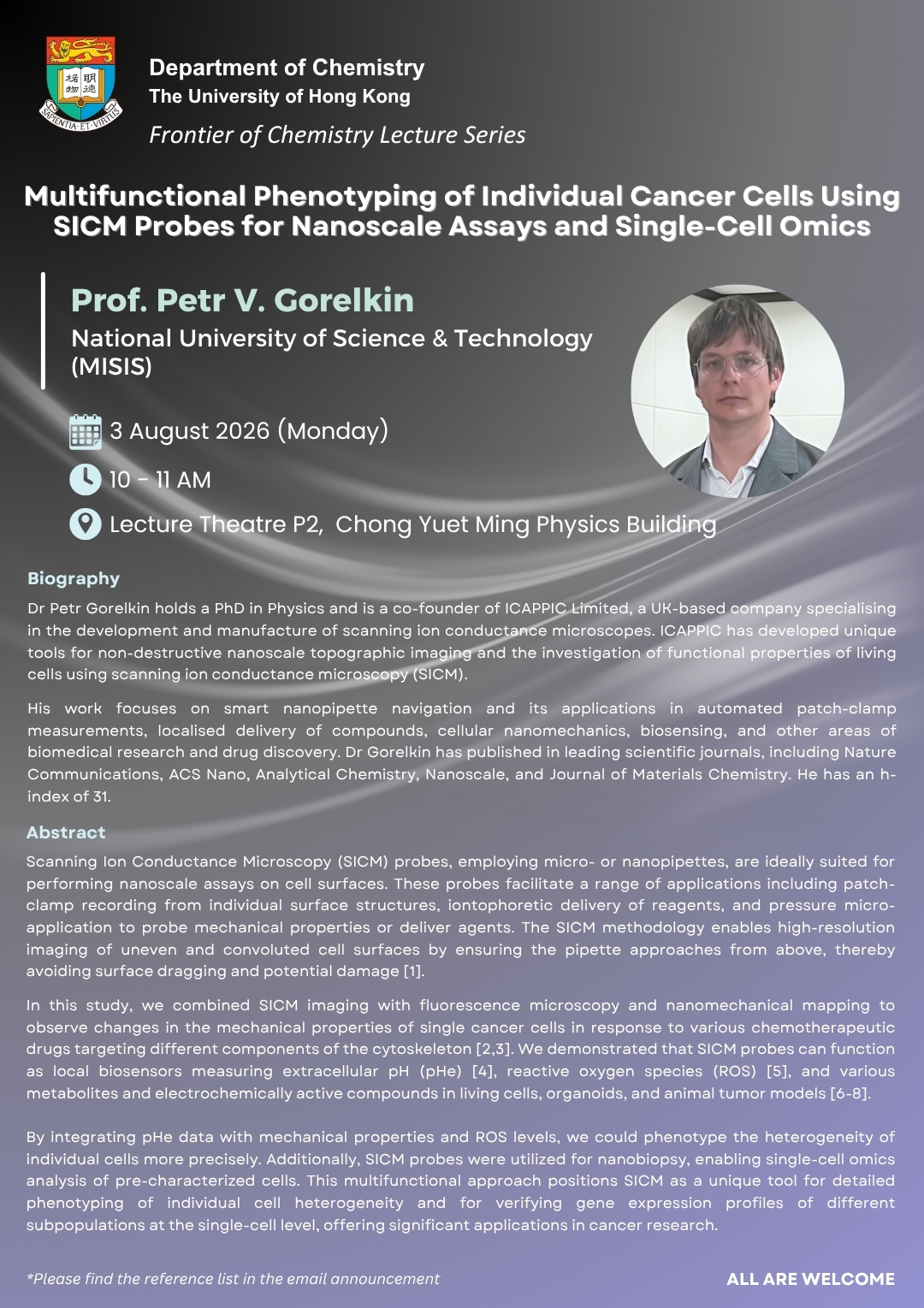
Title:
Multifunctional Phenotyping of Individual Cancer Cells Using SICM Probes for Nanoscale Assays and Single-Cell Omics
Schedule:
Date: 3rd August, 2026 (Monday)
Time: 10 - 11 am (HKT)
Venue: Lecture Theatre P2, Chong Yuet Ming Physics Building
Speaker:
Prof. Petr V. Gorelkin
National University of Science & Technology (MISIS)
Biography:
Dr Petr Gorelkin holds a PhD in Physics and is a co-founder of ICAPPIC Limited, a UK-based company specialising in the development and manufacture of scanning ion conductance microscopes. ICAPPIC has developed unique tools for non-destructive nanoscale topographic imaging and the investigation of functional properties of living cells using scanning ion conductance microscopy (SICM).
His work focuses on smart nanopipette navigation and its applications in automated patch-clamp measurements, localised delivery of compounds, cellular nanomechanics, biosensing, and other areas of biomedical research and drug discovery. Dr Gorelkin has published in leading scientific journals, including Nature Communications, ACS Nano, Analytical Chemistry, Nanoscale, and Journal of Materials Chemistry. He has an h-index of 31.
Abstract:
Scanning Ion Conductance Microscopy (SICM) probes, employing micro- or nanopipettes, are ideally suited for performing nanoscale assays on cell surfaces. These probes facilitate a range of applications including patch-clamp recording from individual surface structures, iontophoretic delivery of reagents, and pressure micro-application to probe mechanical properties or deliver agents. The SICM methodology enables high-resolution imaging of uneven and convoluted cell surfaces by ensuring the pipette approaches from above, thereby avoiding surface dragging and potential damage [1].
In this study, we combined SICM imaging with fluorescence microscopy and nanomechanical mapping to observe changes in the mechanical properties of single cancer cells in response to various chemotherapeutic drugs targeting different components of the cytoskeleton [2,3]. We demonstrated that SICM probes can function as local biosensors measuring extracellular pH (pHe) [4], reactive oxygen species (ROS) [5], and various metabolites and electrochemically active compounds in living cells, organoids, and animal tumor models [6-8].
By integrating pHe data with mechanical properties and ROS levels, we could phenotype the heterogeneity of individual cells more precisely. Additionally, SICM probes were utilized for nanobiopsy, enabling single-cell omics analysis of pre-characterized cells. This multifunctional approach positions SICM as a unique tool for detailed phenotyping of individual cell heterogeneity and for verifying gene expression profiles of different subpopulations at the single-cell level, offering significant applications in cancer research.
References:
[1] Novak, P., Li, C., Shevchuk, A. et al. Nanoscale live-cell imaging using hopping probe ion conductance microscopy. Nat Methods 6, 279–281 (2009).
[2] V. Kolmogorov, A. Erofeev et al. Mapping mechanical properties of living cells at nanoscale using intrinsic nanopipette–sample force interactions Nanoscale, (2021),13, 6558-6568
[3] A. Machulkin, A. Uspenskaya et al. Synthesis, Characterization, and Preclinical Evaluation of a Small-Molecule Prostate-Specific Membrane Antigen-Targeted Monomethyl Auristatin E Conjugate, J. Med. Chem. (2021), 64, 23, 17123–17145.
[4] Zhang, Y., Takahashi, Y., Hong, S.P. et al. High-resolution label-free 3D mapping of extracellular pH of single living cells. Nat Commun 10, 5610 (2019).
[5] A. Vaneev, Petr V. Gorelkin et al. In Vitro and In Vivo Electrochemical Measurement of Reactive Oxygen Species After Treatment with Anticancer Drugs. Anal. Chem. 2020, 92, 12, 8010–8014
[6] O. Krasnovskaya, R. Akasov et al. Photoinduced Reduction of Novel Dual-Action Riboplatin Pt(IV) Prodrug. ACS Appl. Mater. Interfaces 2023, 15, 10, 12882–12894.
- - ALL ARE WELCOME --