 Home
Home Intranet
 Faculty of Science
 Contact Us
 EventsSeminars and ConferencesCombining High-Level Spectroscopy with Quantum Chemistry in the Analysis of Catalytic Reaction Mechanisms Back
Combining High-Level Spectroscopy with Quantum Chemistry in the Analysis of Catalytic Reaction Mechanisms
| Date | 25 Aug 2026 |
| Time | 5:30 pm - 6:30 pm (HKT) |
| Venue | Rayson Huang Theatre, Main Campus, The University of Hong Kong |
| Speaker | Prof. Dr. Frank Neese |
| Institution | Department of Molecular Theory and Spectroscopy, Max-Planck Institut für Kohlenforschung |
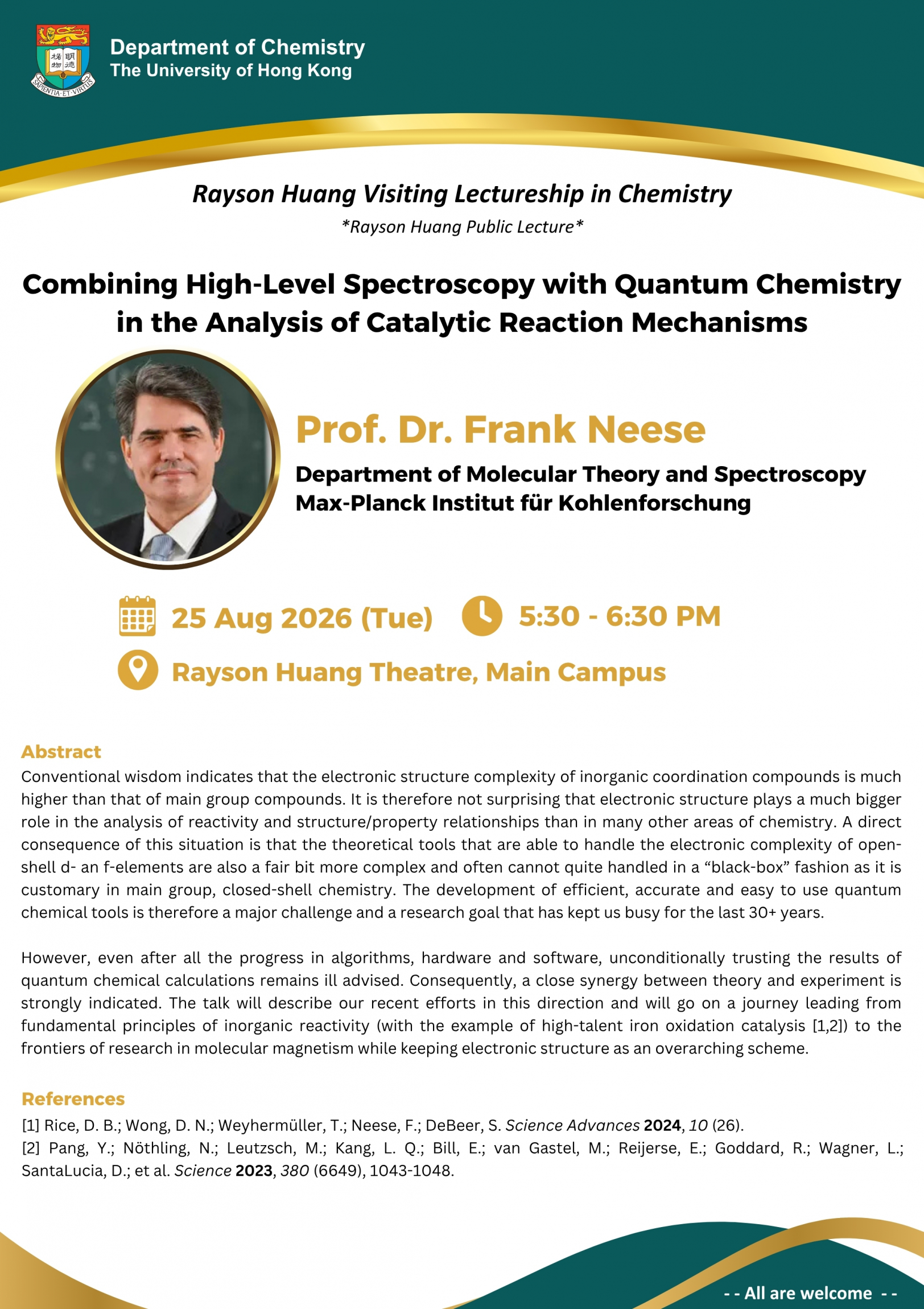
Rayson Huang Visiting Lectureship in Chemistry
*Rayson Huang Public Lecture*
Title:
Combining High-Level Spectroscopy with Quantum Chemistry in the Analysis of Catalytic Reaction Mechanisms
Schedule:
Date: 25th August, 2026 (Tuesday)
Time: 5:30 pm - 6:30 pm (HKT)
Venue: Rayson Huang Theatre, Main Campus, HKU
Speaker:
Prof. Dr. Frank Neese
Department of Molecular Theory and Spectroscopy
Max-Planck Institut für Kohlenforschung
Abstract:
Conventional wisdom indicates that the electronic structure complexity of inorganic coordination compounds is much higher than that of main group compounds. It is therefore not surprising that electronic structure plays a much bigger role in the analysis of reactivity and structure/property relationships than in many other areas of chemistry. A direct consequence of this situation is that the theoretical tools that are able to handle the electronic complexity of open-shell d- an f-elements are also a fair bit more complex and often cannot quite handled in a “black-box” fashion as it is customary in main group, closed-shell chemistry. The development of efficient, accurate and easy to use quantum chemical tools is therefore a major challenge and a research goal that has kept us busy for the last 30+ years.
However, even after all the progress in algorithms, hardware and software, unconditionally trusting the results of quantum chemical calculations remains ill advised. Consequently, a close synergy between theory and experiment is strongly indicated. The talk will describe our recent efforts in this direction and will go on a journey leading from fundamental principles of inorganic reactivity (with the example of high-talent iron oxidation catalysis [1,2]) to the frontiers of research in molecular magnetism while keeping electronic structure as an overarching scheme.
References:
[1] Rice, D. B.; Wong, D. N.; Weyhermüller, T.; Neese, F.; DeBeer, S. Science Advances 2024, 10 (26).
[2] Pang, Y.; Nöthling, N.; Leutzsch, M.; Kang, L. Q.; Bill, E.; van Gastel, M.; Reijerse, E.; Goddard, R.; Wagner, L.; SantaLucia, D.; et al. Science 2023, 380 (6649), 1043-1048.
- - ALL ARE WELCOME --