 Home
Home Intranet
 Faculty of Science
 Contact Us
 EventsSeminars and ConferencesN- and P-Bridged Cyclodextrins for Catalytic, Photochemical, Supramolecular, and Chiroptical Sensing Applications Back
N- and P-Bridged Cyclodextrins for Catalytic, Photochemical, Supramolecular, and Chiroptical Sensing Applications
| Date | 26 Oct 2026 |
| Time | 6:00 - 6:50 pm (HKT) |
| Venue | Lecture Theatre P2, Chong Yuet Ming Physics Building |
| Speaker | Prof. Dominique Armspach |
| Institution | University of Strasbourg |
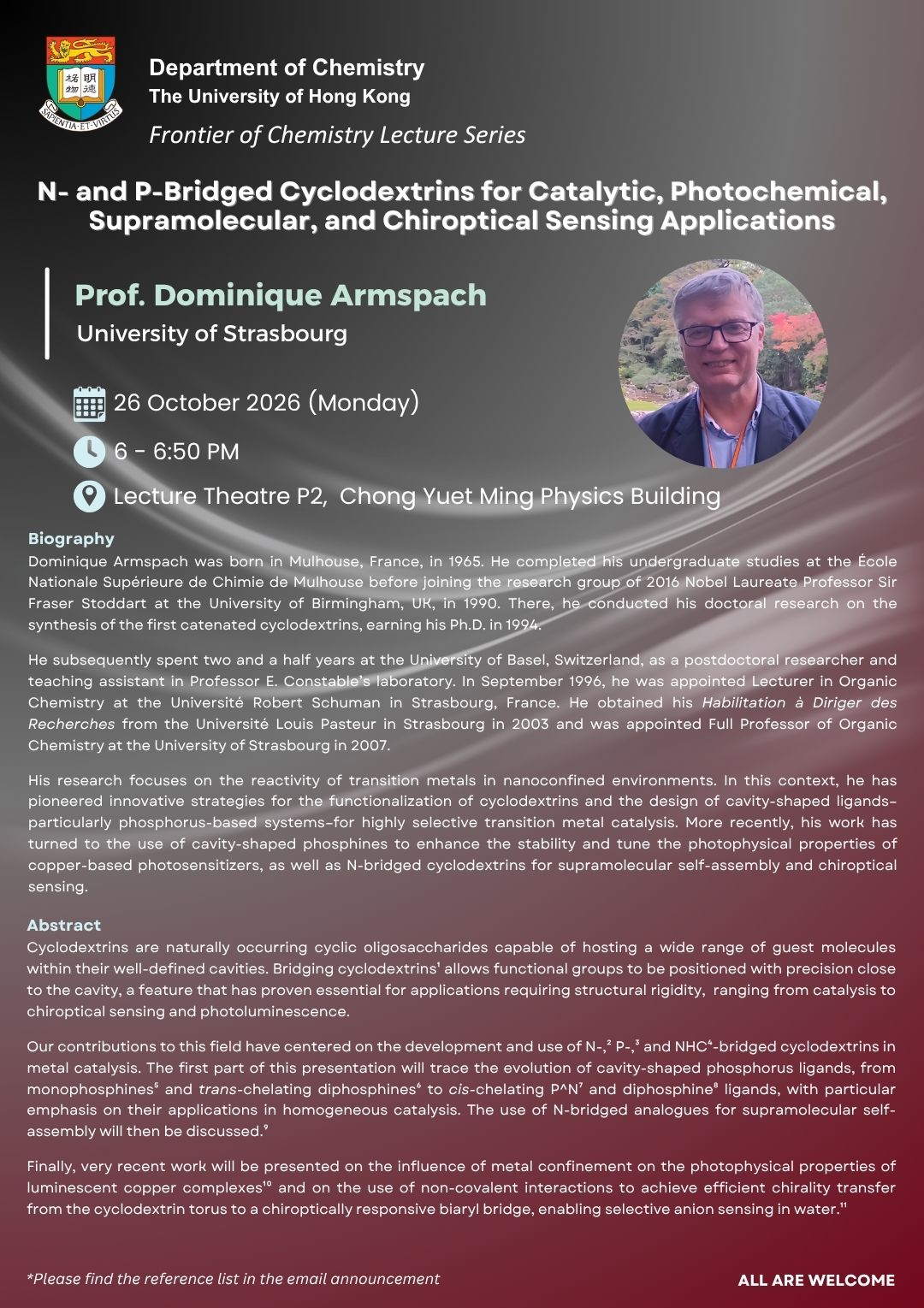
Title:
N- and P-Bridged Cyclodextrins for Catalytic, Photochemical, Supramolecular, and Chiroptical Sensing Applications
Schedule:
Date: 26th October, 2026 (Monday)
Time: 6 - 6:50 pm (HKT)
Venue: Lecture Theatre P2, Chong Yuet Ming Physics Building
Speaker:
Prof. Dominique Armspach
University of Strasbourg
Biography:
Dominique Armspach was born in Mulhouse, France, in 1965. He completed his undergraduate studies at the École Nationale Supérieure de Chimie de Mulhouse before joining the research group of 2016 Nobel Laureate Professor Sir Fraser Stoddart at the University of Birmingham, UK, in 1990. There, he conducted his doctoral research on the synthesis of the first catenated cyclodextrins, earning his Ph.D. in 1994.
He subsequently spent two and a half years at the University of Basel, Switzerland, as a postdoctoral researcher and teaching assistant in Professor E. Constable’s laboratory. In September 1996, he was appointed Lecturer in Organic Chemistry at the Université Robert Schuman in Strasbourg, France. He obtained his Habilitation à Diriger des Recherches from the Université Louis Pasteur in Strasbourg in 2003 and was appointed Full Professor of Organic Chemistry at the University of Strasbourg in 2007.
His research focuses on the reactivity of transition metals in nanoconfined environments. In this context, he has pioneered innovative strategies for the functionalization of cyclodextrins and the design of cavity-shaped ligands–particularly phosphorus-based systems–for highly selective transition metal catalysis. More recently, his work has turned to the use of cavity-shaped phosphines to enhance the stability and tune the photophysical properties of copper-based photosensitizers, as well as N-bridged cyclodextrins for supramolecular self-assembly and chiroptical sensing.
Abstract:
Cyclodextrins are naturally occurring cyclic oligosaccharides capable of hosting a wide range of guest molecules within their well-defined cavities. Bridging cyclodextrins¹ allows functional groups to be positioned with precision close to the cavity, a feature that has proven essential for applications requiring structural rigidity, ranging from catalysis to chiroptical sensing and photoluminescence.
Our contributions to this field have centered on the development and use of N-,² P-,³ and NHC⁴-bridged cyclodextrins in metal catalysis. The first part of this presentation will trace the evolution of cavity-shaped phosphorus ligands, from monophosphines⁵ and trans-chelating diphosphines⁶ to cis-chelating P^N⁷ and diphosphine⁸ ligands, with particular emphasis on their applications in homogeneous catalysis. The use of N-bridged analogues for supramolecular self-assembly will then be discussed.⁹
Finally, very recent work will be presented on the influence of metal confinement on the photophysical properties of luminescent copper complexes¹⁰ and on the use of non-covalent interactions to achieve efficient chirality transfer from the cyclodextrin torus to a chiroptically responsive biaryl bridge, enabling selective anion sensing in water.¹¹
References:
(1) Engeldinger, E.; Armspach, D.; Matt, D. Capped Cyclodextrins. Chem. Rev. 2003, 103 (11), 4147-4173.
(2) Sechet, D.; Kaya, Z.; Phan, T. A.; Jouffroy, M.; Bentouhami, E.; Armspach, D.; Matt, D.; Toupet, L. Aza-Capped Cyclodextrins for Intra-Cavity Metal Complexation. Chem. Commun. 2017, 53 (85), 11717-11720.
(3) Jouffroy, M.; Armspach, D.; Matt, D. Cyclodextrin and Phosphorus(III): a Versatile Combination for Coordination Chemistry and Catalysis. Dalton Trans. 2015, 44 (29), 12942-12969.
(4) Kaya, Z.; Andna, L.; Matt, D.; Bentouhami, E.; Djukic, J. P.; Armspach, D. Benzimidazolium- and Benzimidazolilydene-Capped Cyclodextrins: New Perspectives in Anion Encapsulation and Gold-Catalyzed Cycloisomerization of 1,6-Enynes. Chem. Eur. J. 2018, 24, 17921-17926.
(5) Engeldinger, E.; Poorters, L.; Armspach, D.; Matt, D.; Toupet, L. Diastereospecific Synthesis of Phosphinidene-Capped Cyclodextrins Leading to "Introverted" Ligands. Chem. Commun. 2004, (6), 634-635.
(6) Poorters, L.; Armspach, D.; Matt, D.; Toupet, L.; Choua, S.; Turek, P. Synthesis and Properties of TRANSDIP, a Rigid Chelator Built upon a Cyclodextrin Cavity: is TRANSDIP an Authentic trans-Spanning Ligand? Chem. Eur. J. 2007, 13 (34), 9448-9461.
(7) Li, Y.; Pelzer, K.; Sechet, D.; Creste, G.; Matt, D.; Braunstein, P.; Armspach, D. A Cavity-Shaped cis-Chelating P,N Ligand for Highly Selective Nickel-Catalysed Ethylene Dimerisation. Dalton Trans. 2022, 51 (30), 11226-11230.
(8) Li, Y.; Morais, S. F. D.; Han, M. Y.; Phan, T. A.; Creste, G.; Jouffroy, M.; Matt, D.; Djukic, J. P.; Cornaton, Y.; Braunstein, P.; Pelzer, K.; Armspach, D. Cis-Chelating Diphosphanes for Intracavity Nickel(II)-Catalyzed Ethylene Oligomerization. Chem. Eur. J. 2025, 31 (34), e202501188.
(9) Kolb, M.; Benjaffel, M.; Faller, P.; Raibaut, L.; Armspach, D. Cationic Permethylated Cyclodextrins Capable of Self-Assembling Into Linear Nanostructures in Water. Chem. Eur. J. 2026, 32 (25), e71029.
(10) Phan, T. A.; Armaroli, N.; Moncada, A. S.; Bandini, E.; Delavaux-Nicot, B.; Nierengarten, J. F.; Armspach, D. Stable Luminescent [Cu(NN)(PP)]+ Complexes Incorporating a b-Cyclodextrin-Based Diphosphane Ligand with Metal-Confining Properties. Angew. Chem. Int. Ed. 2023, 62 (6), e202214638.
(11) Preda, G.; Cognata, S. L.; Pedraza-González, L.; Carlier, L.; Kolb, M.; Pescitelli, G.; Amendola, V.; Armspach, D.; Pasini, D. Manipulating Stereo-communication in Binaphthol-Bridged α- and β-Cyclodextrins to Develop β-Selective Chiroptical pH Switching and Anion Sensing in Water. Org. Chem. Front. 2025, 12 (23), 6450-6459.
- - ALL ARE WELCOME - -