 Home
Home Intranet
 Faculty of Science
 Contact Us

The Impact of Molecular Interfaces on CO2 Reduction
| Date | 29 May 2026 |
| Time | 4:00 pm - 5:00 pm (HKT) |
| Venue | Lecture Theatre P2, Chong Yuet Ming Physics Building |
| Speaker | Prof. Ruquan Ye |
| Institution | Department of Chemistry, City University of Hong Kong |
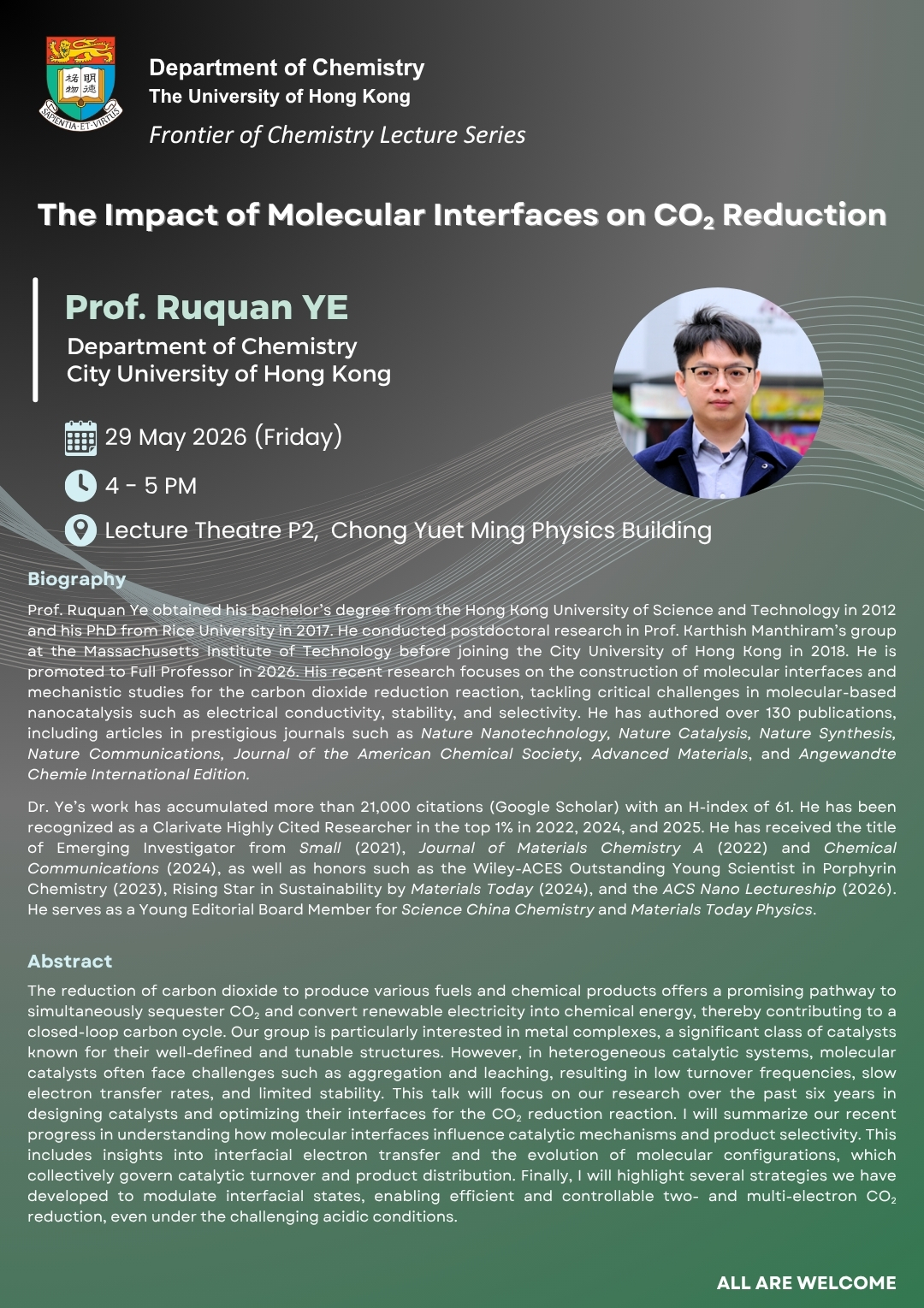
Title:
The Impact of Molecular Interfaces on CO2 Reduction
Schedule:
Date: 29th May, 2026 (Friday)
Time: 4 - 5 pm (HKT)
Venue: Lecture Theatre P2, Chong Yuet Ming Physics Building
Speaker:
Prof. Ruquan YE
Department of Chemistry
City University of Hong Kong
Biography:
Prof. Ruquan Ye obtained his bachelor’s degree from the Hong Kong University of Science and Technology in 2012 and his PhD from Rice University in 2017. He conducted postdoctoral research in Prof. Karthish Manthiram’s group at the Massachusetts Institute of Technology before joining the City University of Hong Kong in 2018. He is promoted to Full Professor in 2026. His recent research focuses on the construction of molecular interfaces and mechanistic studies for the carbon dioxide reduction reaction, tackling critical challenges in molecular-based nanocatalysis such as electrical conductivity, stability, and selectivity. He has authored over 130 publications, including articles in prestigious journals such as Nature Nanotechnology, Nature Catalysis, Nature Synthesis, Nature Communications, Journal of the American Chemical Society, Advanced Materials, and Angewandte Chemie International Edition.
D. Ye’s work has accumulated more than 21,000 citations (Google Scholar) with an H-index of 61. He has been recognized as a Clarivate Highly Cited Researcher in the top 1% in 2022, 2024, and 2025. He has received the title of Emerging Investigator from Small (2021), Journal of Materials Chemistry A (2022) and Chemical Communications (2024), as well as honors such as the Wiley-ACES Outstanding Young Scientist in Porphyrin Chemistry (2023), Rising Star in Sustainability by Materials Today (2024), and the ACS Nano Lectureship (2026). He serves as a Young Editorial Board Member for Science China Chemistry and Materials Today Physics.
Abstract:
The reduction of carbon dioxide to produce various fuels and chemical products offers a promising pathway to simultaneously sequester CO2 and convert renewable electricity into chemical energy, thereby contributing to a closed-loop carbon cycle. Our group is particularly interested in metal complexes, a significant class of catalysts known for their well-defined and tunable structures. However, in heterogeneous catalytic systems, molecular catalysts often face challenges such as aggregation and leaching, resulting in low turnover frequencies, slow electron transfer rates, and limited stability. This talk will focus on our research over the past six years in designing catalysts and optimizing their interfaces for the CO2 reduction reaction. I will summarize our recent progress in understanding how molecular interfaces influence catalytic mechanisms and product selectivity. This includes insights into interfacial electron transfer and the evolution of molecular configurations, which collectively govern catalytic turnover and product distribution. Finally, I will highlight several strategies we have developed to modulate interfacial states, enabling efficient and controllable two- and multi-electron CO2 reduction, even under the challenging acidic conditions.
- - ALL ARE WELCOME - -