 Home
Home Intranet
 Faculty of Science
 Contact Us

From Strain to Stereochemistry: A Design Principle
| Date | 11 Jun 2026 |
| Time | 5:00 pm - 6:00 pm (HKT) |
| Venue | Lecture Theatre P2, Chong Yuet Ming Physics Building |
| Speaker | Prof. Ilan Marek |
| Institution | Schulich Faculty of Chemistry, The Resnick Sustainability Center for Catalysis, Technion - Israel Institute of Technology |
Title:
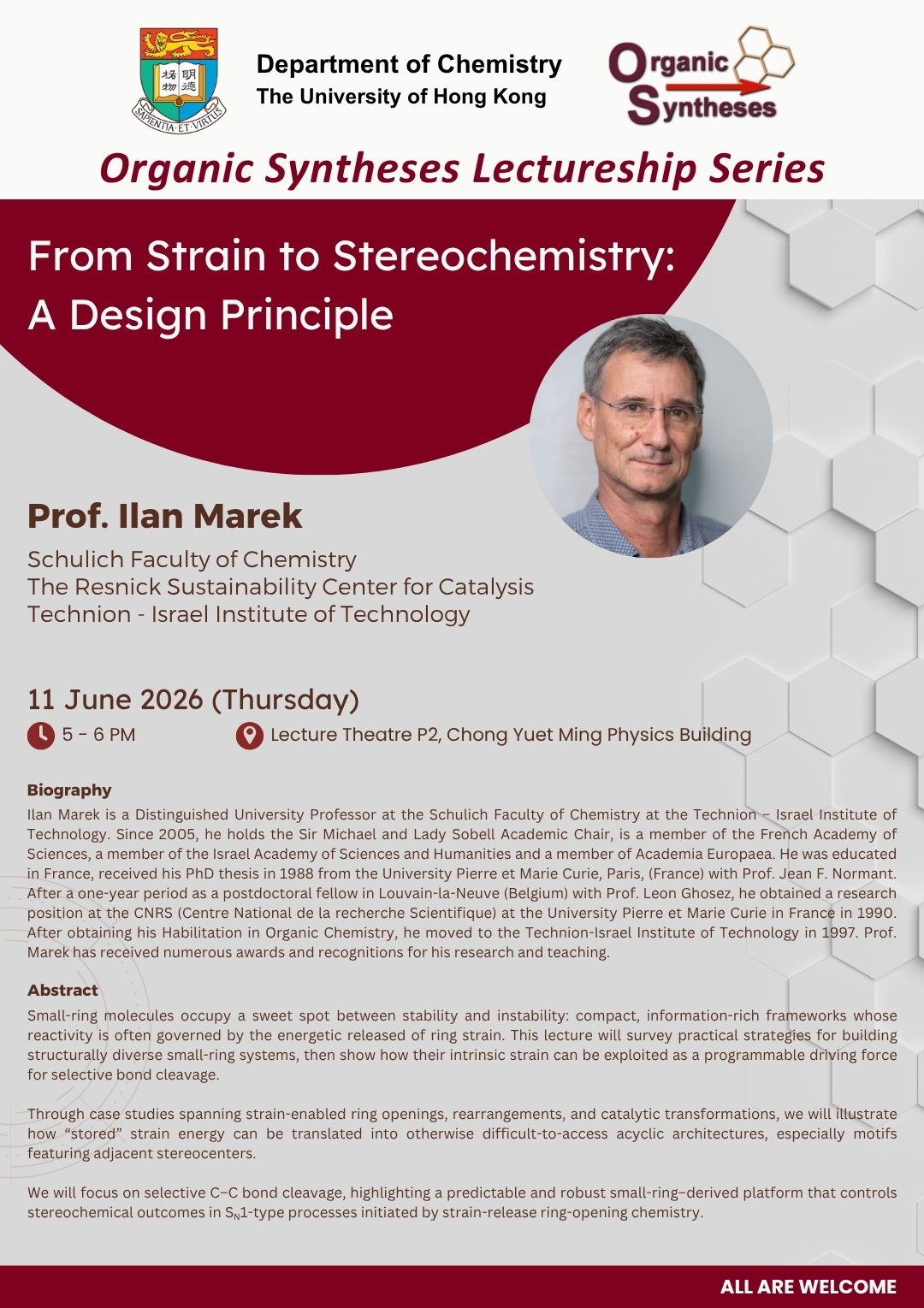
From Strain to Stereochemistry: A Design Principle
Schedule:
Date: 11th June, 2026 (Thursday)
Time: 5 - 6 pm (HKT)
Venue: Lecture Theatre P2, Chong Yuet Ming Physics Building
Speaker:
Prof. Ilan Marek
Schulich Faculty of Chemistry
The Resnick Sustainability Center for Catalysis
Technion - Israel Institute of Technology
Biography:
Ilan Marek is a Distinguished University Professor at the Schulich Faculty of Chemistry at the Technion – Israel Institute of Technology. Since 2005, he holds the Sir Michael and Lady Sobell Academic Chair, is a member of the French Academy of Sciences, a member of the Israel Academy of Sciences and Humanities and a member of Academia Europaea. He was educated in France, received his PhD thesis in 1988 from the University Pierre et Marie Curie, Paris, (France) with Prof. Jean F. Normant. After a one-year period as a postdoctoral fellow in Louvain-la-Neuve (Belgium) with Prof. Leon Ghosez, he obtained a research position at the CNRS (Centre National de la recherche Scientifique) at the University Pierre et Marie Curie in France in 1990. After obtaining his Habilitation in Organic Chemistry, he moved to the Technion-Israel Institute of Technology in 1997. Prof. Marek has received numerous awards and recognitions for his research and teaching.
Abstract:
Small-ring molecules occupy a sweet spot between stability and instability: compact, information-rich frameworks whose reactivity is often governed by the energetic released of ring strain. This lecture will survey practical strategies for building structurally diverse small-ring systems, then show how their intrinsic strain can be exploited as a programmable driving force for selective bond cleavage.
Through case studies spanning strain-enabled ring openings, rearrangements, and catalytic transformations, we will illustrate how “stored” strain energy can be translated into otherwise difficult-to-access acyclic architectures, especially motifs featuring adjacent stereocenters.
We will focus on selective C–C bond cleavage, highlighting a predictable and robust small-ring–derived platform that controls stereochemical outcomes in SN1-type processes initiated by strain-release ring-opening chemistry.
- - ALL ARE WELCOME - -