 Home
Home Intranet
 Faculty of Science
 Contact Us
 EventsSeminars and ConferencesIntercellular Cytoplasmic Transfer Through Open-ended Membrane Tubular Connections Back
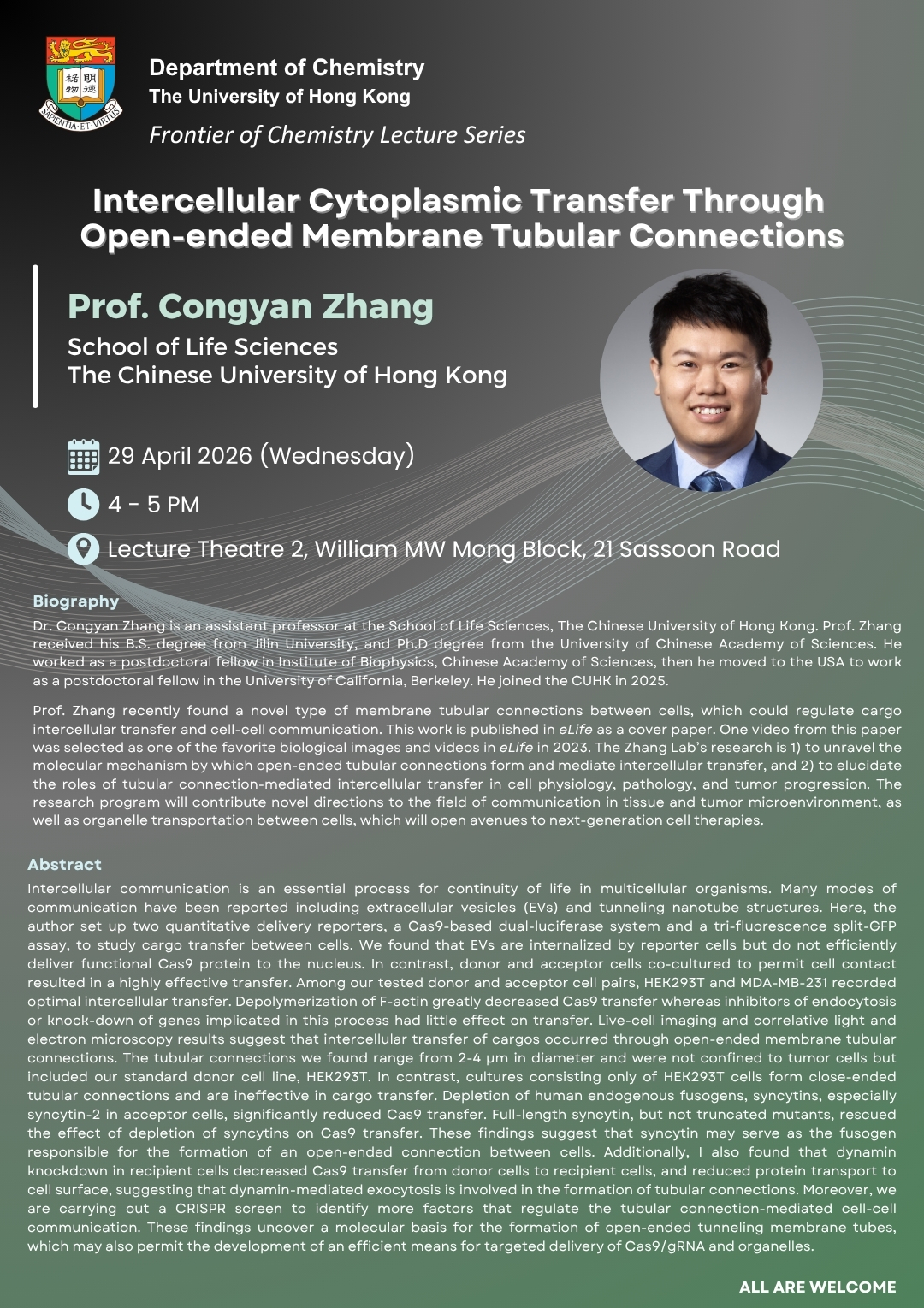
Intercellular Cytoplasmic Transfer Through Open-ended Membrane Tubular Connections
| Date | 29 Apr 2026 |
| Time | 4:00 pm - 5:00 pm (HKT) |
| Venue | Lecture Theatre 2, William MW Mong Block, 21 Sassoon Road |
| Speaker | Prof. Congyan Zhang |
| Institution | School of Life Sciences, The Chinese University of Hong Kong |
Title:
Intercellular Cytoplasmic Transfer Through Open-ended Membrane Tubular Connections
Schedule:
Date: 29th April, 2026 (Wednesday)
Time: 4 - 5 pm (HKT)
Venue: Lecture Theatre 2, William MW Mong Block, 21 Sassoon Road
Speaker:
Prof. Congyan Zhang
School of Life Sciences
The Chinese University of Hong Kong
Biography:
Dr. Congyan Zhang is an assistant professor at the School of Life Sciences, The Chinese University of Hong Kong. Prof. Zhang received his B.S. degree from Jilin University, and Ph.D degree from the University of Chinese Academy of Sciences. He worked as a postdoctoral fellow in Institute of Biophysics, Chinese Academy of Sciences, then he moved to the USA to work as a postdoctoral fellow in the University of California, Berkeley. He joined the CUHK in 2025.
Prof. Zhang recently found a novel type of membrane tubular connections between cells, which could regulate cargo intercellular transfer and cell-cell communication. This work is published in eLife as a cover paper. One video from this paper was selected as one of the favorite biological images and videos in eLife in 2023. The Zhang Lab’s research is 1) to unravel the molecular mechanism by which open-ended tubular connections form and mediate intercellular transfer, and 2) to elucidate the roles of tubular connection-mediated intercellular transfer in cell physiology, pathology, and tumor progression. The research program will contribute novel directions to the field of communication in tissue and tumor microenvironment, as well as organelle transportation between cells, which will open avenues to next-generation cell therapies.
Abstract:
Intercellular communication is an essential process for continuity of life in multicellular organisms. Many modes of communication have been reported including extracellular vesicles (EVs) and tunneling nanotube structures. Here, the author set up two quantitative delivery reporters, a Cas9-based dual-luciferase system and a tri-fluorescence split-GFP assay, to study cargo transfer between cells. We found that EVs are internalized by reporter cells but do not efficiently deliver functional Cas9 protein to the nucleus. In contrast, donor and acceptor cells co-cultured to permit cell contact resulted in a highly effective transfer. Among our tested donor and acceptor cell pairs, HEK293T and MDA-MB-231 recorded optimal intercellular transfer. Depolymerization of F-actin greatly decreased Cas9 transfer whereas inhibitors of endocytosis or knock-down of genes implicated in this process had little effect on transfer. Live-cell imaging and correlative light and electron microscopy results suggest that intercellular transfer of cargos occurred through open-ended membrane tubular connections. The tubular connections we found range from 2-4 μm in diameter and were not confined to tumor cells but included our standard donor cell line, HEK293T. In contrast, cultures consisting only of HEK293T cells form close-ended tubular connections and are ineffective in cargo transfer. Depletion of human endogenous fusogens, syncytins, especially syncytin-2 in acceptor cells, significantly reduced Cas9 transfer. Full-length syncytin, but not truncated mutants, rescued the effect of depletion of syncytins on Cas9 transfer. These findings suggest that syncytin may serve as the fusogen responsible for the formation of an open-ended connection between cells. Additionally, I also found that dynamin knockdown in recipient cells decreased Cas9 transfer from donor cells to recipient cells, and reduced protein transport to cell surface, suggesting that dynamin-mediated exocytosis is involved in the formation of tubular connections. Moreover, we are carrying out a CRISPR screen to identify more factors that regulate the tubular connection-mediated cell-cell communication. These findings uncover a molecular basis for the formation of open-ended tunneling membrane tubes, which may also permit the development of an efficient means for targeted delivery of Cas9/gRNA and organelles.
- - ALL ARE WELCOME - -