 Home
Home Intranet
 Faculty of Science
 Contact Us
 EventsSeminars and ConferencesChemical Probes in Antifungal Research: Decoding Mechanisms, Resistance, and Drug Discovery Concepts Back
Chemical Probes in Antifungal Research: Decoding Mechanisms, Resistance, and Drug Discovery Concepts
| Date | 03 Jun 2026 |
| Time | 10:30 am - 11:30 am (HKT) |
| Venue | Lecture Theatre P2, Chong Yuet Ming Physics Building |
| Speaker | Prof. Micha Fridman |
| Institution | School of Chemistry, The Raymond and Beverley Sackler Faculty of Exact Sciences, Tel Aviv University |
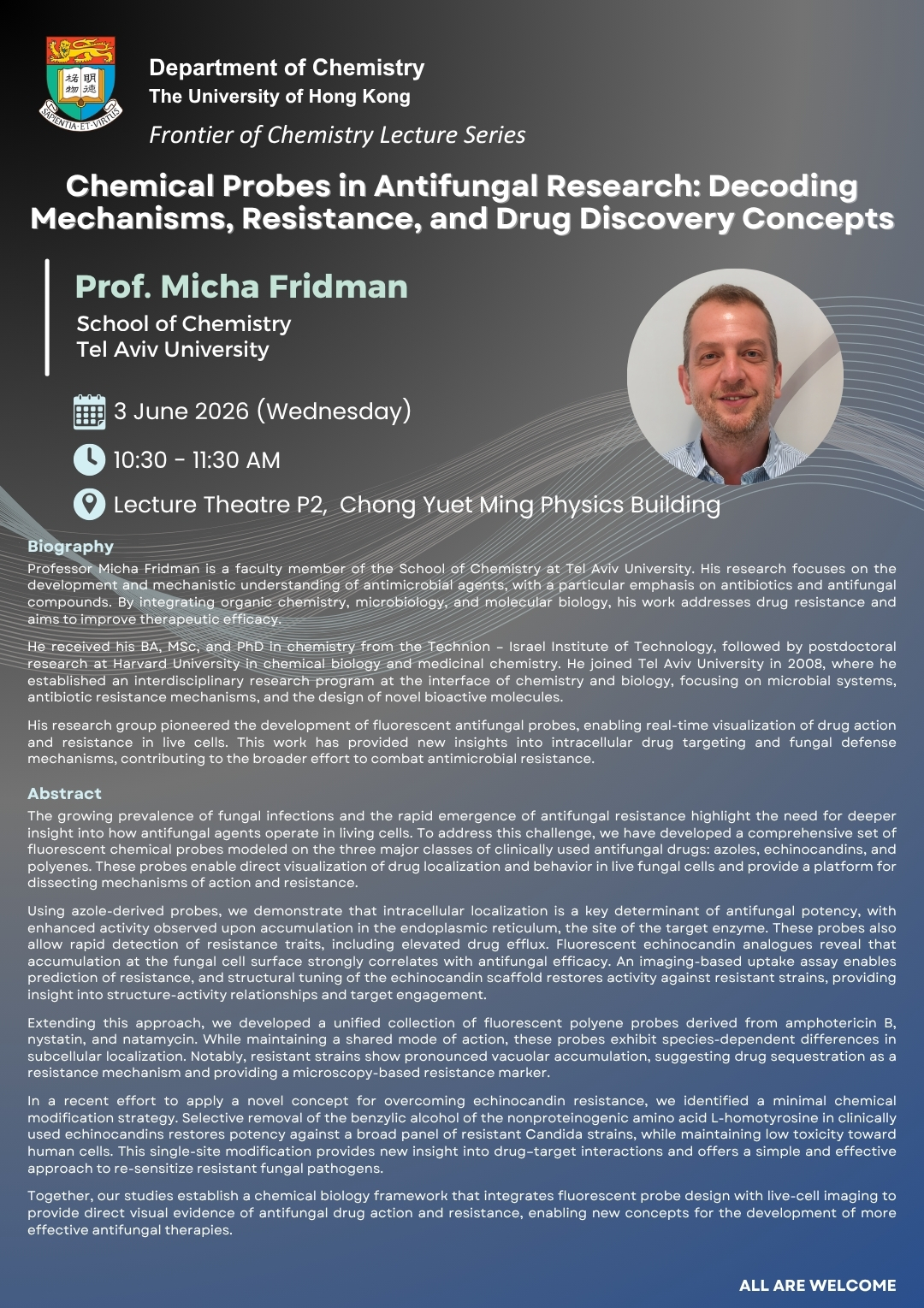
Title:
Chemical Probes in Antifungal Research: Decoding Mechanisms, Resistance, and Drug Discovery Concepts
Schedule:
Date: 3rd June, 2026 (Wednesday)
Time: 10:30 - 11:30 am (HKT)
Venue: Lecture Theatre P2, Chong Yuet Ming Physics Building
Speaker:
Prof. Micha Fridman
School of Chemistry
Tel Aviv University
Biography:
Professor Micha Fridman is a faculty member of the School of Chemistry at Tel Aviv University. His research focuses on the development and mechanistic understanding of antimicrobial agents, with a particular emphasis on antibiotics and antifungal compounds. By integrating organic chemistry, microbiology, and molecular biology, his work addresses drug resistance and aims to improve therapeutic efficacy.
He received his BA, MSc, and PhD in chemistry from the Technion – Israel Institute of Technology, followed by postdoctoral research at Harvard University in chemical biology and medicinal chemistry. He joined Tel Aviv University in 2008, where he established an interdisciplinary research program at the interface of chemistry and biology, focusing on microbial systems, antibiotic resistance mechanisms, and the design of novel bioactive molecules.
His research group pioneered the development of fluorescent antifungal probes, enabling real-time visualization of drug action and resistance in live cells. This work has provided new insights into intracellular drug targeting and fungal defense mechanisms, contributing to the broader effort to combat antimicrobial resistance.
Abstract:
The growing prevalence of fungal infections and the rapid emergence of antifungal resistance highlight the need for deeper insight into how antifungal agents operate in living cells. To address this challenge, we have developed a comprehensive set of fluorescent chemical probes modeled on the three major classes of clinically used antifungal drugs: azoles, echinocandins, and polyenes. These probes enable direct visualization of drug localization and behavior in live fungal cells and provide a platform for dissecting mechanisms of action and resistance.
Using azole-derived probes, we demonstrate that intracellular localization is a key determinant of antifungal potency, with enhanced activity observed upon accumulation in the endoplasmic reticulum, the site of the target enzyme. These probes also allow rapid detection of resistance traits, including elevated drug efflux. Fluorescent echinocandin analogues reveal that accumulation at the fungal cell surface strongly correlates with antifungal efficacy. An imaging-based uptake assay enables prediction of resistance, and structural tuning of the echinocandin scaffold restores activity against resistant strains, providing insight into structure-activity relationships and target engagement.
Extending this approach, we developed a unified collection of fluorescent polyene probes derived from amphotericin B, nystatin, and natamycin. While maintaining a shared mode of action, these probes exhibit species-dependent differences in subcellular localization. Notably, resistant strains show pronounced vacuolar accumulation, suggesting drug sequestration as a resistance mechanism and providing a microscopy-based resistance marker.
In a recent effort to apply a novel concept for overcoming echinocandin resistance, we identified a minimal chemical modification strategy. Selective removal of the benzylic alcohol of the nonproteinogenic amino acid L-homotyrosine in clinically used echinocandins restores potency against a broad panel of resistant Candida strains, while maintaining low toxicity toward human cells. This single-site modification provides new insight into drug–target interactions and offers a simple and effective approach to re-sensitize resistant fungal pathogens.
Together, our studies establish a chemical biology framework that integrates fluorescent probe design with live-cell imaging to provide direct visual evidence of antifungal drug action and resistance, enabling new concepts for the development of more effective antifungal therapies.
- - ALL ARE WELCOME - -