 Home
Home Intranet
 Faculty of Science
 Contact Us
 EventsSeminars and ConferencesMapping RNA Localization: New Chemical Tools for Functional Exploration Back
Mapping RNA Localization: New Chemical Tools for Functional Exploration
| Date | 02 Mar 2026 |
| Time | 4:00 pm - 4:50 pm (HKT) |
| Venue | Lecture Theatre T2, Meng Wah Complex |
| Speaker | Prof. Ying LI |
| Institution | Department of Chemistry, The University of Hong Kong |
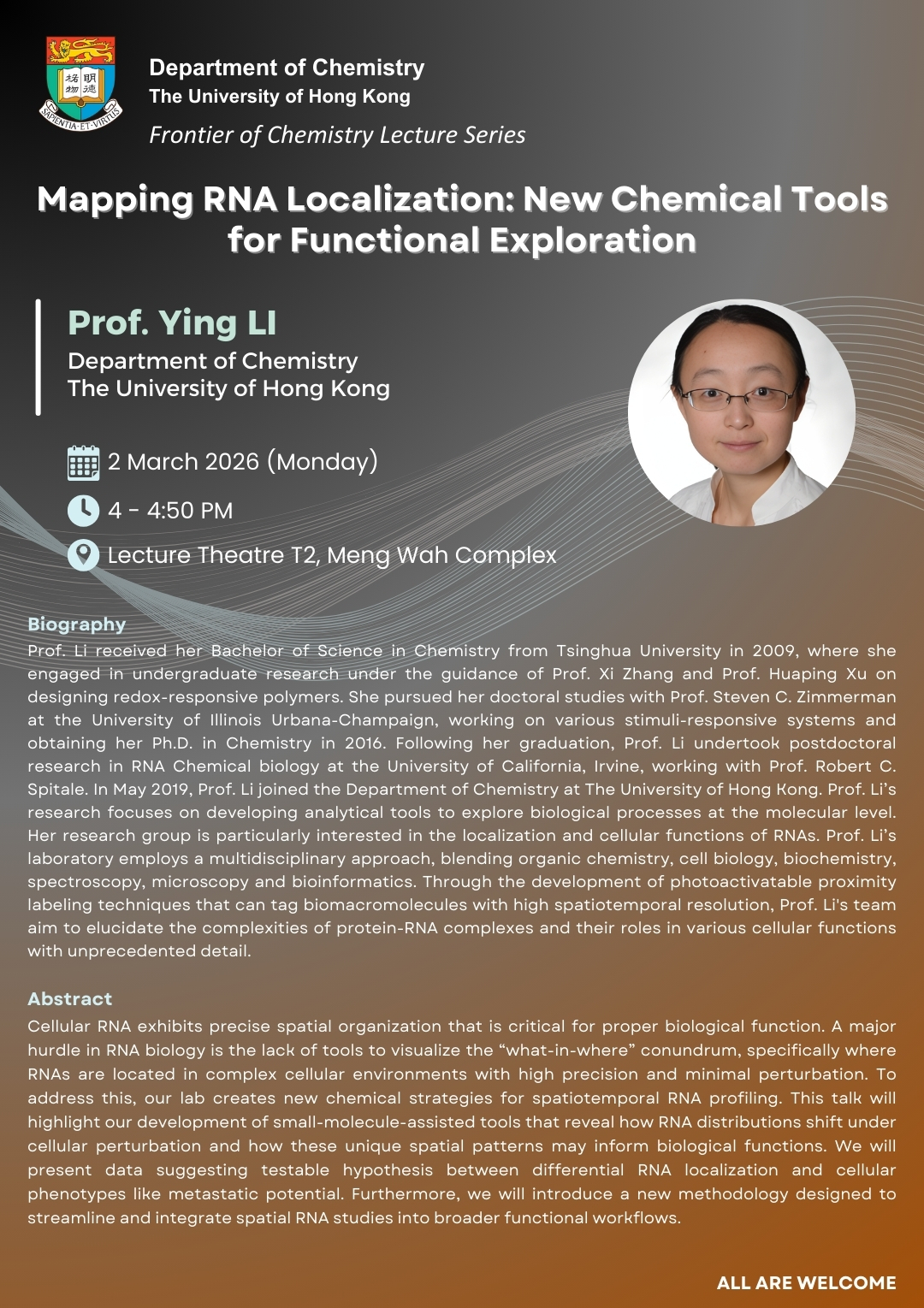
Title:
Mapping RNA Localization: New Chemical Tools for Functional Exploration
Schedule:
Date: 2nd March, 2026 (Monday)
Time: 4 - 4:50 pm (HKT)
Venue: Lecture Theatre T2, Meng Wah Complex
Speaker:
Prof. Ying LI
Department of Chemistry
The University of Hong Kong
Biography:
Prof. Li received her Bachelor of Science in Chemistry from Tsinghua University in 2009, where she engaged in undergraduate research under the guidance of Prof. Xi Zhang and Prof. Huaping Xu on designing redox-responsive polymers. She pursued her doctoral studies with Prof. Steven C. Zimmerman at the University of Illinois Urbana-Champaign, working on various stimuli-responsive systems and obtaining her Ph.D. in Chemistry in 2016. Following her graduation, Prof. Li undertook postdoctoral research in RNA Chemical biology at the University of California, Irvine, working with Prof. Robert C. Spitale. In May 2019, Prof. Li joined the Department of Chemistry at The University of Hong Kong. Prof. Li’s research focuses on developing analytical tools to explore biological processes at the molecular level. Her research group is particularly interested in the localization and cellular functions of RNAs. Prof. Li’s laboratory employs a multidisciplinary approach, blending organic chemistry, cell biology, biochemistry, spectroscopy, microscopy and bioinformatics. Through the development of photoactivatable proximity labeling techniques that can tag biomacromolecules with high spatiotemporal resolution, Prof. Li's team aim to elucidate the complexities of protein-RNA complexes and their roles in various cellular functions with unprecedented detail.
Abstract:
Cellular RNA exhibits precise spatial organization that is critical for proper biological function. A major hurdle in RNA biology is the lack of tools to visualize the “what-in-where” conundrum, specifically where RNAs are located in complex cellular environments with high precision and minimal perturbation. To address this, our lab creates new chemical strategies for spatiotemporal RNA profiling. This talk will highlight our development of small-molecule-assisted tools that reveal how RNA distributions shift under cellular perturbation and how these unique spatial patterns may inform biological functions. We will present data suggesting testable hypothesis between differential RNA localization and cellular phenotypes like metastatic potential. Furthermore, we will introduce a new methodology designed to streamline and integrate spatial RNA studies into broader functional workflows.
- - ALL ARE WELCOME - -