 Home
Home Intranet
 Faculty of Science
 Contact Us

Metal Halide Perovskite-Containing Multijunction Photovoltaics
| Date | 05 Feb 2026 |
| Time | 11:00 am - 11:50 am (HKT) |
| Venue | Lecture Theatre P4, Chong Yuet Ming Physics Building |
| Speaker | Dr. Shuaifeng HU |
| Institution | University of Oxford |
Title:
Metal Halide Perovskite-Containing Multijunction Photovoltaics
Schedule:
Date: 5th February, 2026 (Thursday)
Time: 11 - 11:50 am (HKT)
Venue: Lecture Theatre P4, Chong Yuet Ming Physics Building
Speaker:
Dr. Shuaifeng HU
University of Oxford
Abstract:
Metal halide perovskite is a class of ABX3-type crystalline materials − in most cases − with the A being both the organic (e.g., formamidinium, methylammonium) and inorganic (e.g., Cs+) monovalent cations, B being divalent cations, e.g., Pb2+, Sn2+, or their mixture, and X being the halide anions, e.g., I−, Br−, and/or Cl−. Thanks to their superior bandgap tunability and high absorption coefficient, metal halide perovskites show great potential for fabricating single- and multi-junction photovoltaics capable of achieving high power conversion efficiencies at low cost[1,2,3].
In this seminar, we will first introduce the fundamentals of hybrid perovskite materials and their thin-film processing protocols for the fabrication of solar cell devices[4]. Then, we will exemplify the research with our recent investigations on a specific narrow bandgap (~1.25 eV) perovskite material, i.e., mixed tin−lead perovskites, and their single-junction solar cells, covering the control of the Sn(II) oxidation[5], interface carrier extraction[6,7], and in-situ surface reaction[8], as well as the understanding of the solution chemistry and resultant thin-film crystallization[9,10], from experimental and theoretical aspects. Building on the development of a full range of wide bandgap neat lead perovskites (from ~1.5 to ~2.0 eV), in the end, we will showcase the integration of these perovskite sub-cells into “all-perovskite” monolithic two-terminal double-, triple-, and first-ever quadruple-junction solar cells, with the best power conversion efficiencies of approaching 30% and photovoltage values of up to 4.94 V[9]. In addition, we will discuss the longevity limits of this emerging multi-junction photovoltaics and propose promising strategies for enhancing the light and temperature stability of the involved sub-cells. Furthermore, we will also share insights and recent progress obtained in “perovskite-on-silicon” multi-junction cells.
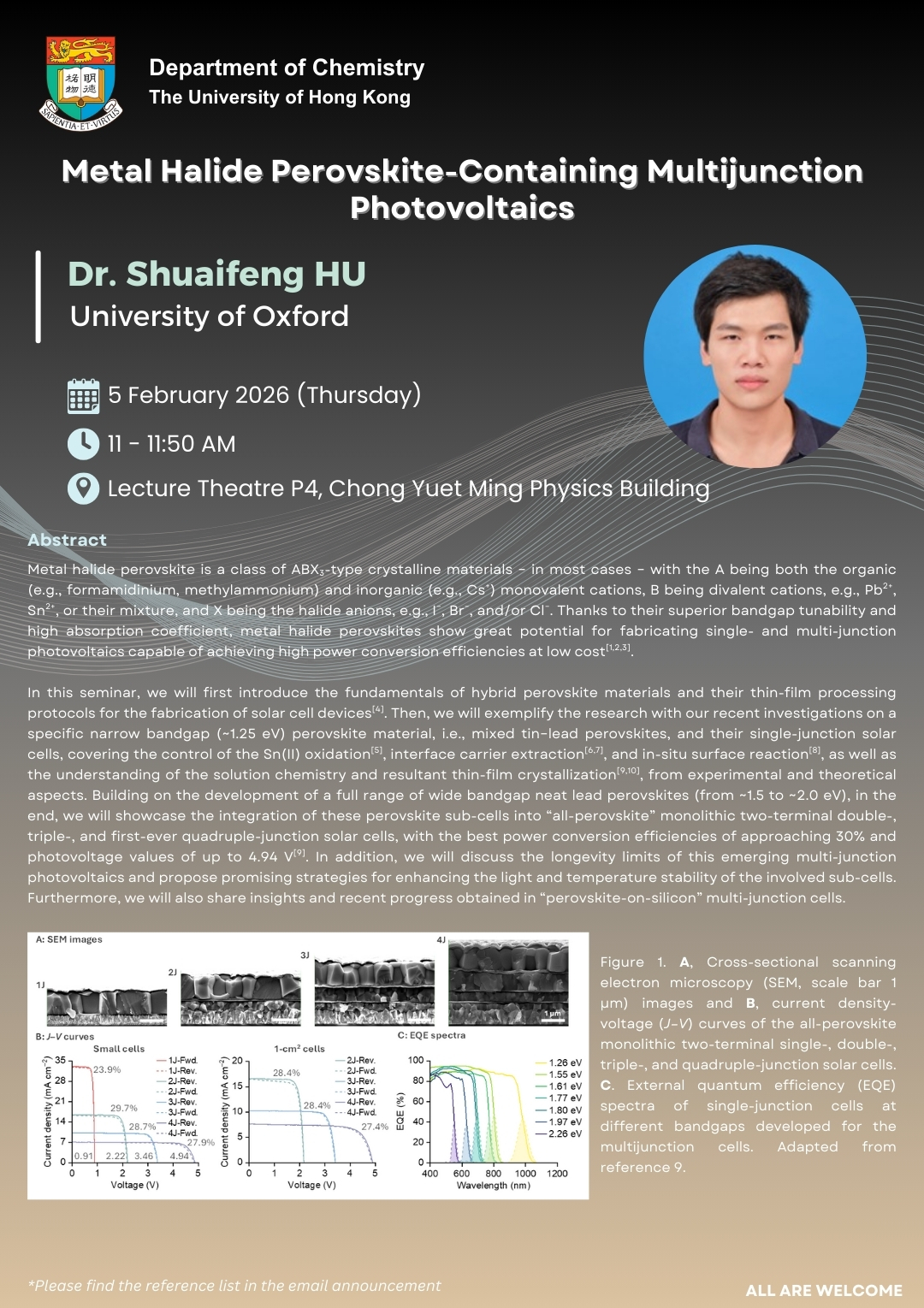
Figure 1. A, Cross-sectional scanning electron microscopy (SEM, scale bar 1 µm) images and B, current density-voltage (J–V) curves of the all-perovskite monolithic two-terminal single-, double-, triple-, and quadruple-junction solar cells. C. External quantum efficiency (EQE) spectra of single-junction cells at different bandgaps developed for the multijunction cells. Adapted from reference 9.
References:
[1] G. E. Eperon, et al., Nat. Rev. Chem. 2017, 1, 0095.
[2] S. Hu et al., Chem. Rev. 2024, 124, 4079–4123.
[3] S. Hu & H. J. Snaith, Nature 2025, 648, 544–546.
[4] Z. Li et al., Nat. Rev. Mater. 2018, 3, 18017.
[5] S. Hu et al., Chem. Sci. 2021, 12, 13513–13519.
[6] S. Hu et al., Energy Environ. Sci. 2022, 15, 2096–2107.
[7] S. Hu et al., ACS Appl. Mater. Interfaces 2022, 14, 56290–56297.
[8] S. Hu et al., Adv. Mater. 2023, 35, 2208320.
[9] S. Hu et al., Nature 2025, 639, 93–101.
[10] S. Hu et al., Angew. Chem. Int. Ed. 2025, e202514010.
- - ALL ARE WELCOME - -