 Home
Home Intranet
 Faculty of Science
 Contact Us
 EventsSeminars and ConferencesFrom Chemical Genetics to Molecular Clamps: Covalent Strategies for Biological Discovery Back
From Chemical Genetics to Molecular Clamps: Covalent Strategies for Biological Discovery
| Date | 04 Feb 2026 |
| Time | 5:00 pm - 6:00 pm (HKT) |
| Venue | Lecture Theatre T3, Meng Wah Complex |
| Speaker | Dr. Haoxin LI |
| Institution | The Scripps Research Institute |
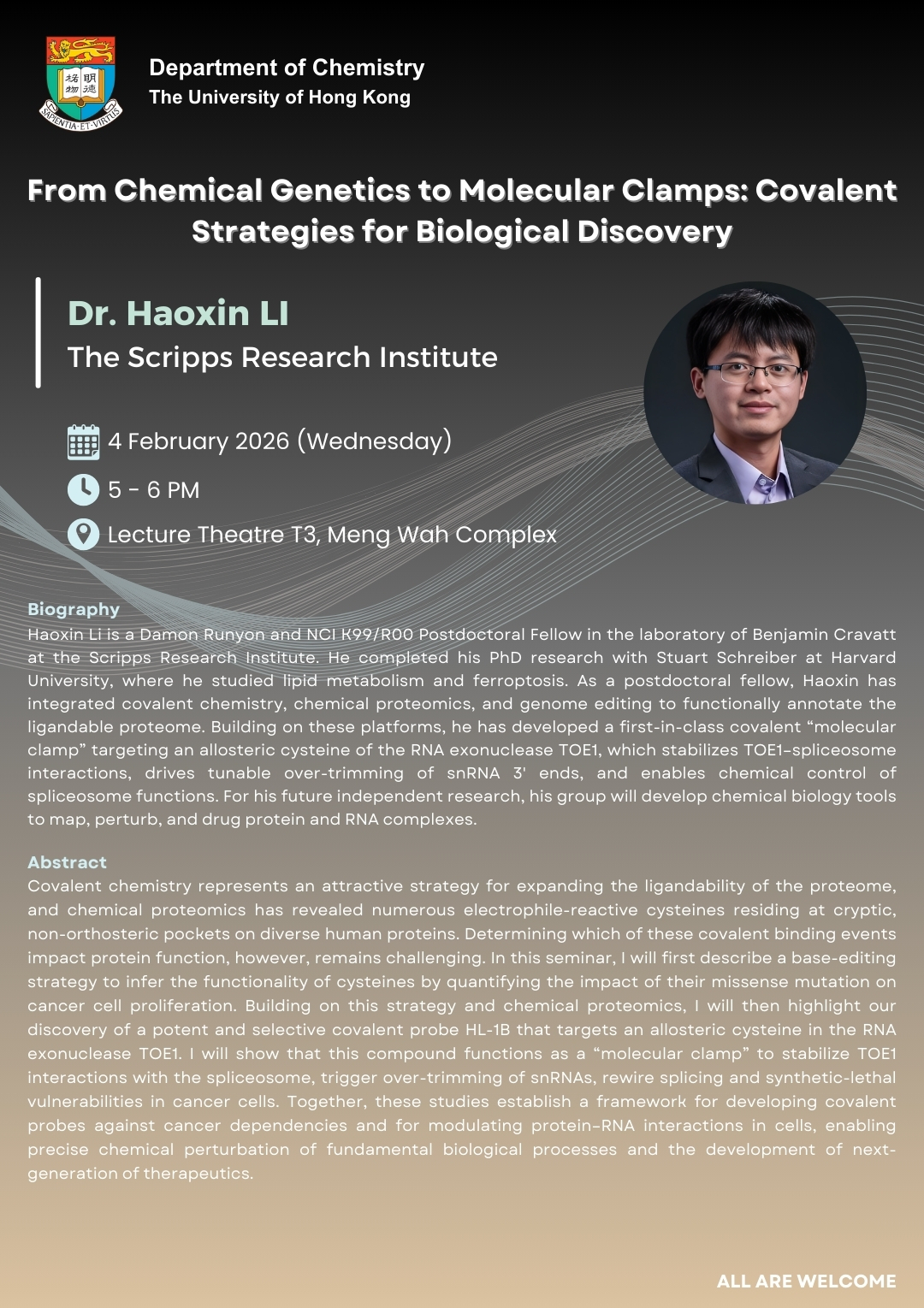
Dr. Haoxin LI
Covalent chemistry represents an attractive strategy for expanding the ligandability of the proteome, and chemical proteomics has revealed numerous electrophile-reactive cysteines residing at cryptic, non-orthosteric pockets on diverse human proteins. Determining which of these covalent binding events impact protein function, however, remains challenging. In this seminar, I will first describe a base-editing strategy to infer the functionality of cysteines by quantifying the impact of their missense mutation on cancer cell proliferation. Building on this strategy and chemical proteomics, I will then highlight our discovery of a potent and selective covalent probe HL-1B that targets an allosteric cysteine in the RNA exonuclease TOE1. I will show that this compound functions as a “molecular clamp” to stabilize TOE1 interactions with the spliceosome, trigger over-trimming of snRNAs, rewire splicing and synthetic-lethal vulnerabilities in cancer cells. Together, these studies establish a framework for developing covalent probes against cancer dependencies and for modulating protein–RNA interactions in cells, enabling precise chemical perturbation of fundamental biological processes and the development of next-generation of therapeutics.