 Home
Home Intranet
 Faculty of Science
 Contact Us

Se/Te-containing polymers for biomedical application
| Date | 09 Jan 2026 |
| Time | 11:00 am - 12:00 pm (HKT) |
| Venue | Lecture Theatre P1, Chong Yuet Ming Chemistry Building |
| Speaker | Prof. Huaping XU |
| Institution | Department of Chemistry Tsinghua University |
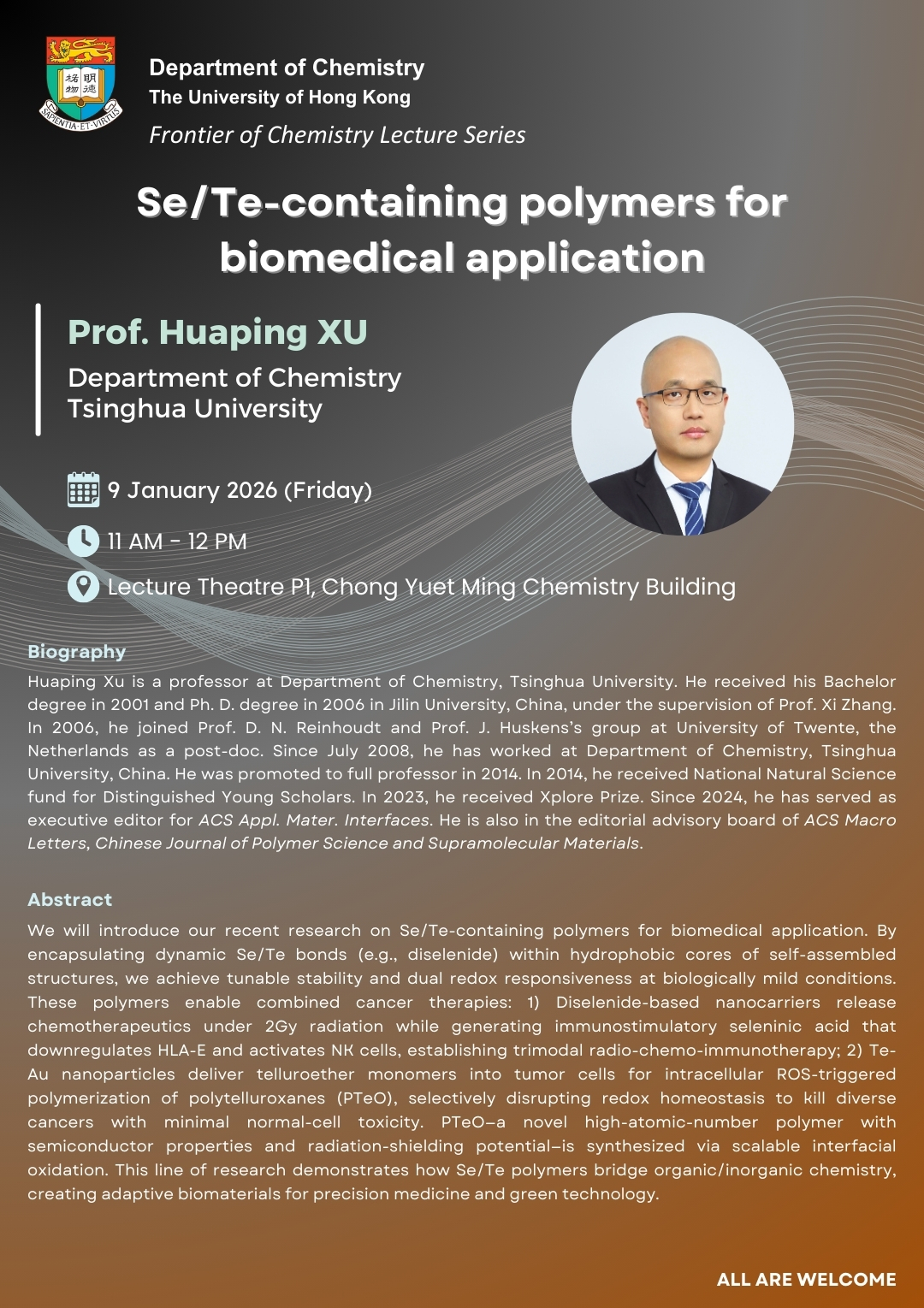
Title:
Se/Te-containing polymers for biomedical application
Schedule:
Date: 9th January, 2026 (Friday)
Time: 11 am - 12 pm (HKT)
Venue: Lecture Theatre P1, Chong Yuet Ming Chemistry Building
Speaker:
Prof. Huaping XU
Department of Chemistry
Tsinghua University
Biography:
Huaping Xu is a professor at Department of Chemistry, Tsinghua University. He received his Bachelor degree in 2001 and Ph. D. degree in 2006 in Jilin University, China, under the supervision of Prof. Xi Zhang. In 2006, he joined Prof. D. N. Reinhoudt and Prof. J. Huskens’s group at University of Twente, the Netherlands as a post-doc. Since July 2008, he has worked at Department of Chemistry, Tsinghua University, China. He was promoted to full professor in 2014. In 2014, he received National Natural Science fund for Distinguished Young Scholars. In 2023, he received Xplore Prize. Since 2024, he has served as executive editor for ACS Appl. Mater. Interfaces. He is also in the editorial advisory board of ACS Macro Letters, Chinese Journal of Polymer Science and Supramolecular Materials.
Abstract:
We will introduce our recent research on Se/Te-containing polymers for biomedical application. By encapsulating dynamic Se/Te bonds (e.g., diselenide) within hydrophobic cores of self-assembled structures, we achieve tunable stability and dual redox responsiveness at biologically mild conditions. These polymers enable combined cancer therapies: 1) Diselenide-based nanocarriers release chemotherapeutics under 2Gy radiation while generating immunostimulatory seleninic acid that downregulates HLA-E and activates NK cells, establishing trimodal radio-chemo-immunotherapy; 2) Te-Au nanoparticles deliver telluroether monomers into tumor cells for intracellular ROS-triggered polymerization of polytelluroxanes (PTeO), selectively disrupting redox homeostasis to kill diverse cancers with minimal normal-cell toxicity. PTeO—a novel high-atomic-number polymer with semiconductor properties and radiation-shielding potential—is synthesized via scalable interfacial oxidation. This line of research demonstrates how Se/Te polymers bridge organic/inorganic chemistry, creating adaptive biomaterials for precision medicine and green technology.
- - ALL ARE WELCOME - -