 Home
Home Intranet
 Faculty of Science
 Contact Us
 EventsSeminars and ConferencesBetween the Rules: When Chemical Reactivity Defies Conventional Reasoning Back
Between the Rules: When Chemical Reactivity Defies Conventional Reasoning
| Date | 08 Jan 2026 |
| Time | 5:00 pm - 6:00 pm (HKT) |
| Venue | Lecture Theatre P2, Chong Yuet Ming Physics Building |
| Speaker | Prof. Andrei Yudin |
| Institution | Department of Chemistry, University of Toronto |
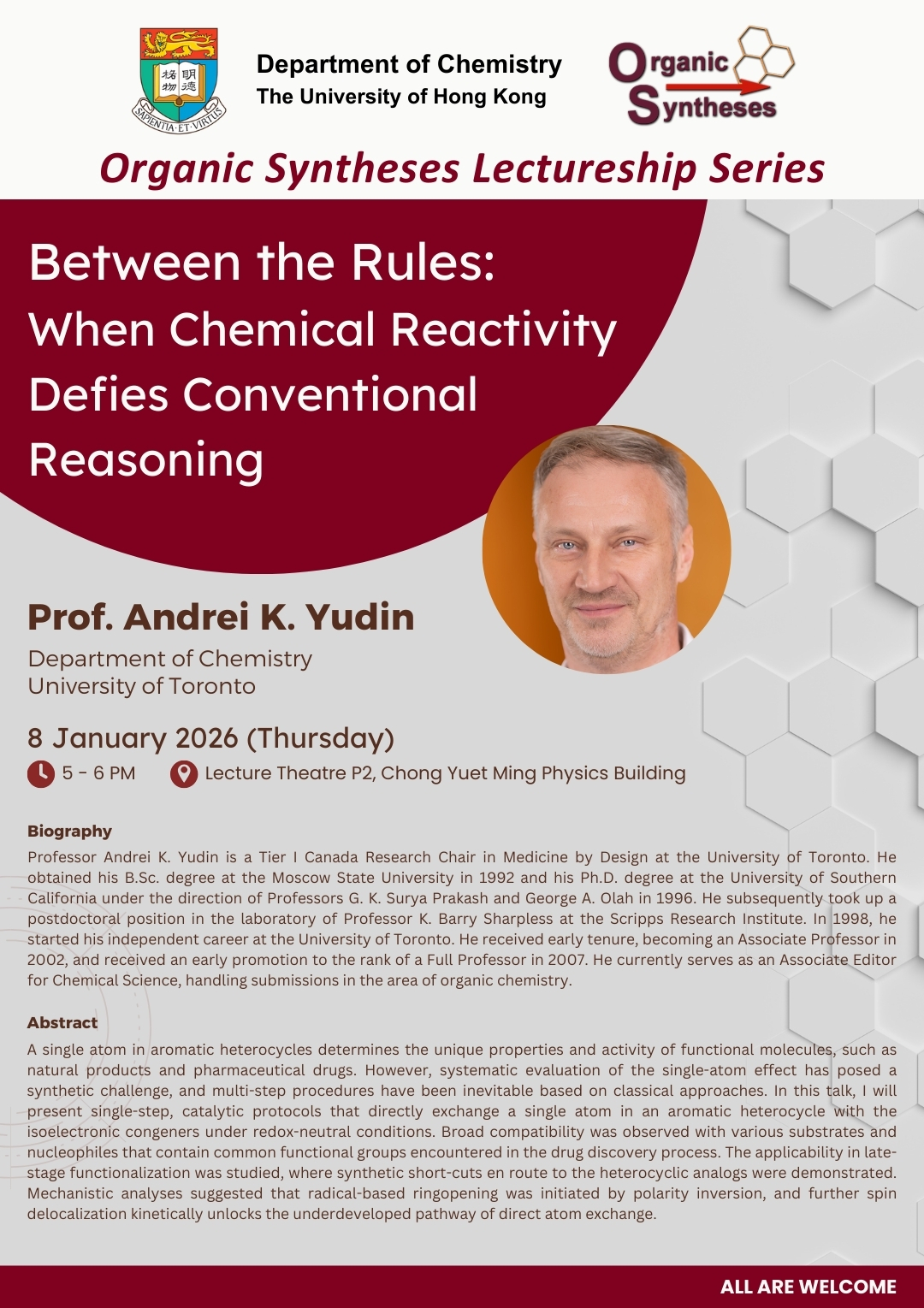
Title:
Between the Rules: When Chemical Reactivity Defies Conventional Reasoning
Schedule:
Date: 8th January, 2026 (Thursday)
Time: 5 - 6 pm (HKT)
Venue: Lecture Theatre P2, Chong Yuet Ming Chemistry Building
Speaker:
Prof. Andrei Yudin
Department of Chemistry
University of Toronto
Biography:
Professor Andrei K. Yudin is a Tier I Canada Research Chair in Medicine by Design at the University of Toronto. He obtained his B.Sc. degree at the Moscow State University in 1992 and his Ph.D. degree at the University of Southern California under the direction of Professors G. K. Surya Prakash and George A. Olah in 1996. He subsequently took up a postdoctoral position in the laboratory of Professor K. Barry Sharpless at the Scripps Research Institute. In 1998, he started his independent career at the University of Toronto. He received early tenure, becoming an Associate Professor in 2002, and received an early promotion to the rank of a Full Professor in 2007. He currently serves as an Associate Editor for Chemical Science, handling submissions in the area of organic chemistry.
Abstract:
A single atom in aromatic heterocycles determines the unique properties and activity of functional molecules, such as natural products and pharmaceutical drugs. However, systematic evaluation of the single-atom effect has posed a synthetic challenge, and multi-step procedures have been inevitable based on classical approaches. In this talk, I will present single-step, catalytic protocols that directly exchange a single atom in an aromatic heterocycle with the isoelectronic congeners under redox-neutral conditions. Broad compatibility was observed with various substrates and nucleophiles that contain common functional groups encountered in the drug discovery process. The applicability in late-stage functionalization was studied, where synthetic short-cuts en route to the heterocyclic analogs were demonstrated. Mechanistic analyses suggested that radical-based ringopening was initiated by polarity inversion, and further spin delocalization kinetically unlocks the underdeveloped pathway of direct atom exchange.
- - ALL ARE WELCOME - -