 Home
Home Intranet
 Faculty of Science
 Contact Us
 EventsSeminars and ConferencesBiologically Inspired Catalytic Systems for Solar-to-Fuel Technologies Back
Biologically Inspired Catalytic Systems for Solar-to-Fuel Technologies
| Date | 04 Dec 2025 |
| Time | 5:00 pm - 6:00 pm (HKT) |
| Venue | Lecture Theatre P1, Chong Yuet Ming Chemistry Building |
| Speaker | Prof. Smaranda C. Marinescu |
| Institution | University of Southern California |
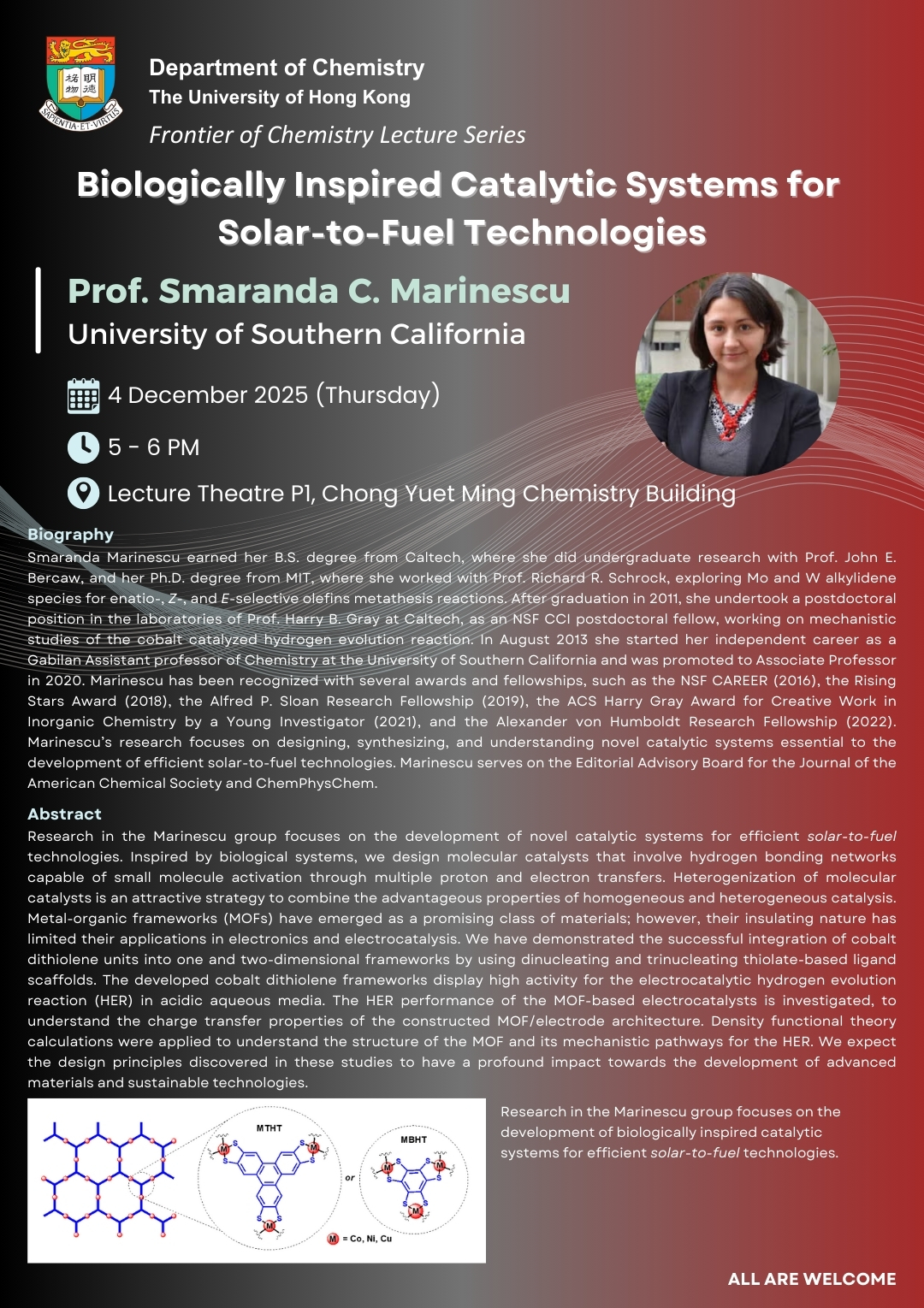
Research in the Marinescu group focuses on the development of novel catalytic systems for efficient solar-to-fuel technologies. Inspired by biological systems, we design molecular catalysts that involve hydrogen bonding networks capable of small molecule activation through multiple proton and electron transfers. Heterogenization of molecular catalysts is an attractive strategy to combine the advantageous properties of homogeneous and heterogeneous catalysis. Metal-organic frameworks (MOFs) have emerged as a promising class of materials; however, their insulating nature has limited their applications in electronics and electrocatalysis. We have demonstrated the successful integration of cobalt dithiolene units into one and two-dimensional frameworks by using dinucleating and trinucleating thiolate-based ligand scaffolds. The developed cobalt dithiolene frameworks display high activity for the electrocatalytic hydrogen evolution reaction (HER) in acidic aqueous media. The HER performance of the MOF-based electrocatalysts is investigated, to understand the charge tr9/10/2025ansfer properties of the constructed MOF/electrode architecture. Density functional theory calculations were applied to understand the structure of the MOF and its mechanistic pathways for the HER. We expect the design principles discovered in these studies to have a profound impact towards the development of advanced materials and sustainable technologies.