 Home
Home Intranet
 Faculty of Science
 Contact Us
 EventsSeminars and ConferencesDelocalized, Asynchronous, Closed-Loop Discovery of Organic Laser Emitters Back
Delocalized, Asynchronous, Closed-Loop Discovery of Organic Laser Emitters
| Date | 08 Jan 2024 |
| Time | 11:00 am - 12:00 noon (HKT) |
| Venue | Lecture theatre P1, Chong Yuet Ming Chemistry Building |
| Speaker | Dr. Han Hao |
| Institution | Department of Chemistry, University of Toronto |
Title:
Delocalized, Asynchronous, Closed-Loop Discovery of Organic Laser Emitters
Schedule:
Date: 8th January, 2024 (Monday)
Time: 11 am - 12 noon (HKT)
Venue: Lecture Theatre P1, Chong Yuet Ming Chemistry Building
Speaker:
Dr. Han Hao
Department of Chemistry
University of Toronto
Biography:
Dr. Han Hao is a Staff Scientist of the Acceleration Consortium at the University of Toronto. He was also a postdoctoral fellow with Prof. Alán Aspuru-Guzik from the Chemistry Department at the University of Toronto. His research focus includes advanced automation and digitization of chemistry, robotics in chemistry, AI-assisted molecule design and high-throughput computations. He also works on deliverable designs and blueprints for the self-driving lab community.
Abstract:
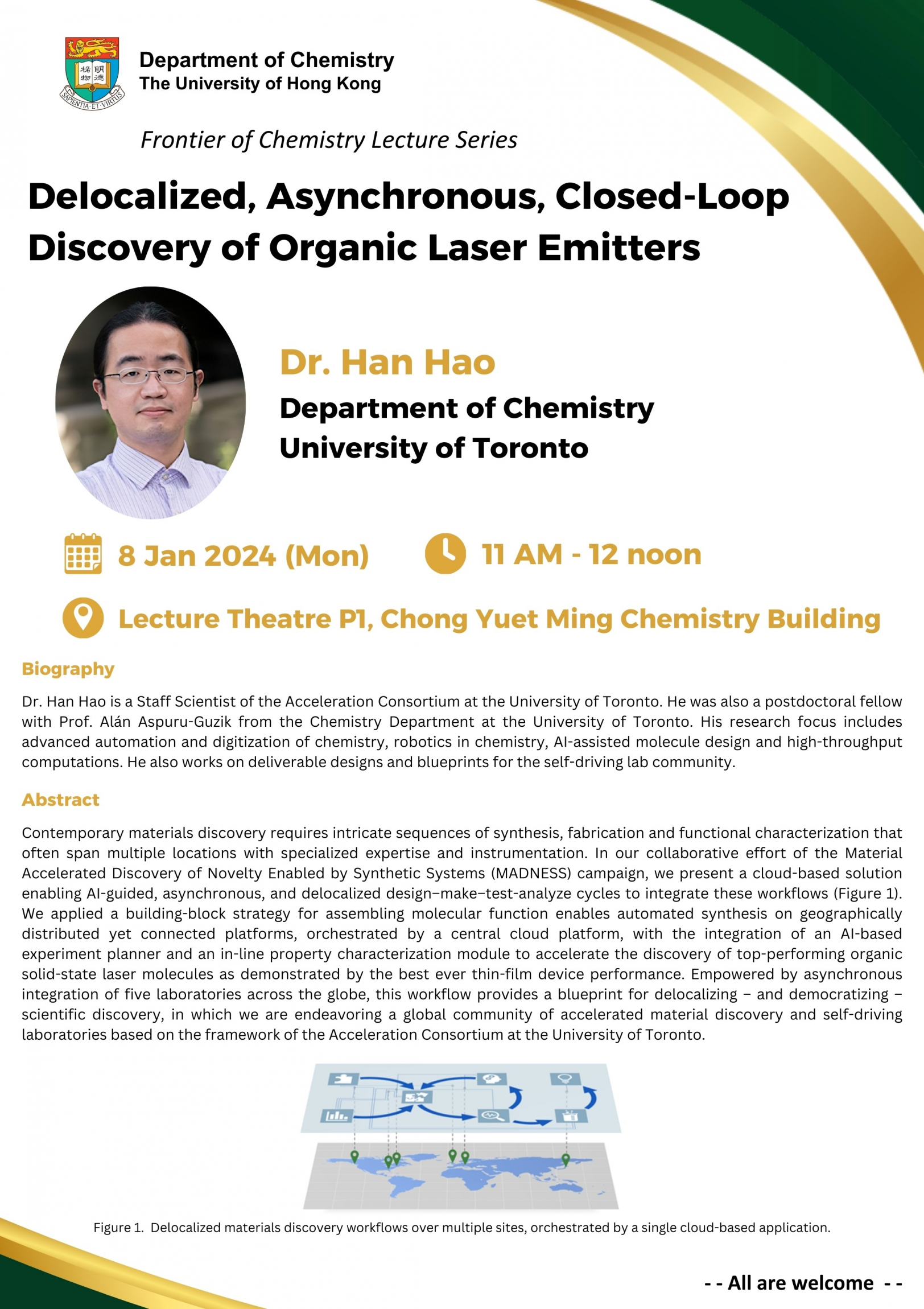
Contemporary materials discovery requires intricate sequences of synthesis, fabrication and functional characterization that often span multiple locations with specialized expertise and instrumentation. In our collaborative effort of the Material Accelerated Discovery of Novelty Enabled by Synthetic Systems (MADNESS) campaign, we present a cloud-based solution enabling AI-guided, asynchronous, and delocalized design–make–test-analyze cycles to integrate these workflows (Figure 1). We applied a building-block strategy for assembling molecular function enables automated synthesis on geographically distributed yet connected platforms, orchestrated by a central cloud platform, with the integration of an AI-based experiment planner and an in-line property characterization module to accelerate the discovery of top-performing organic solid-state laser molecules as demonstrated by the best ever thin-film device performance. Empowered by asynchronous integration of five laboratories across the globe, this workflow provides a blueprint for delocalizing – and democratizing – scientific discovery, in which we are endeavoring a global community of accelerated material discovery and self-driving laboratories based on the framework of the Acceleration Consortium at the University of Toronto.
- ALL ARE WELCOME -